








Merchandise Export from India Scheme (MEIS): Benefits, Eligibility & Application Process
Introduction
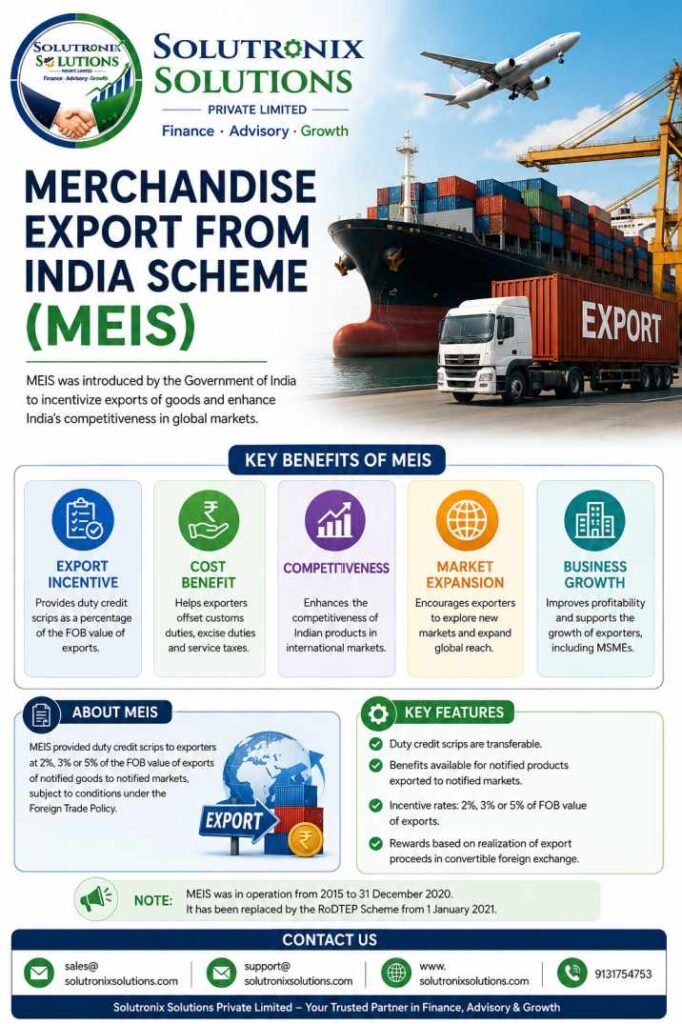
The Merchandise Export from India Scheme (MEIS) was introduced by the Government of India under the Foreign Trade Policy (FTP) 2015-20 to promote exports of goods manufactured in India. The scheme aimed to incentivize exporters by providing duty credit scrips, thereby enhancing India’s export competitiveness in international markets.
Although MEIS has been replaced by the Remission of Duties and Taxes on Exported Products (RoDTEP) Scheme from January 1, 2021, understanding MEIS remains important for businesses reviewing past export incentives, compliance requirements, and export policy developments.
What is the Merchandise Export from India Scheme (MEIS)?
MEIS was launched by the Directorate General of Foreign Trade (DGFT) to encourage the export of notified goods to specified markets. Under the scheme, exporters received duty credit scrips as a percentage of the realized Free on Board (FOB) value of exports.
These scrips could be used to pay customs duties, excise duties, and service taxes, thereby reducing the overall cost of exports.
Objectives of MEIS
The primary objectives of the scheme were:
- Promote exports of goods manufactured in India.
- Enhance India’s global trade competitiveness.
- Offset infrastructural inefficiencies and associated export costs.
- Encourage diversification into new export markets.
- Support small and medium-sized exporters.
Key Features of MEIS
1. Duty Credit Scrips
Exporters received rewards in the form of transferable duty credit scrips.
2. Incentive Rates
Benefits were generally provided at rates of 2%, 3%, or 5% of the FOB value of exports, depending on the product and destination country.
3. Transferability
The duty credit scrips were freely transferable and could be sold to other businesses.
4. Coverage
The scheme covered a wide range of products including:
- Engineering goods
- Pharmaceuticals
- Textiles and garments
- Agricultural products
- Chemicals
- Leather products
Eligibility Criteria for MEIS
To qualify for benefits under MEIS, exporters had to meet the following conditions:
- The exported product must be listed under the notified MEIS schedule.
- The export destination must be a notified market.
- Export proceeds must be realized in convertible foreign exchange.
- The exporter must possess a valid Import Export Code (IEC).
- Shipping bills must indicate the intention to claim MEIS benefits.
Benefits of MEIS
Reduced Export Costs
Duty credit scrips helped exporters offset customs duties and taxes.
Improved Profitability
Financial incentives increased profit margins for exporters.
Enhanced Global Competitiveness
Indian products became more competitive in international markets.
Market Expansion
Exporters were encouraged to enter new international markets.
Application Process for MEIS
Step 1: Export Goods
Export eligible products to notified countries.
Step 2: Realize Export Proceeds
Receive payment in foreign currency and obtain the Bank Realization Certificate (BRC).
Step 3: File Online Application
Submit the application through the DGFT portal along with required documents.
Step 4: Verification
DGFT verifies the application and supporting documents.
Step 5: Issue of Duty Credit Scrip
Upon approval, duty credit scrips are issued to the exporter.
Documents Required
The following documents were generally required:
- Import Export Code (IEC)
- Shipping Bills
- Export Invoices
- Bank Realization Certificate (BRC)
- Digital Signature Certificate (DSC)
- DGFT Application Form
Why Was MEIS Replaced?
The World Trade Organization (WTO) raised concerns that MEIS constituted an export subsidy inconsistent with international trade rules. Consequently, the Government of India introduced the RoDTEP Scheme to provide reimbursement of embedded taxes and duties in a WTO-compliant manner.
MEIS vs RoDTEP
| Particulars | MEIS | RoDTEP |
|---|---|---|
| Objective | Export Incentive | Tax Remission |
| Benefit Type | Duty Credit Scrip | Refund of Embedded Taxes |
| WTO Compliance | Challenged | WTO-Compliant |
| Transferability | Yes | Subject to Government Rules |
| Effective Period | Up to 31 Dec 2020 | From 1 Jan 2021 |
Conclusion
The Merchandise Export from India Scheme (MEIS) played a significant role in promoting Indian exports by providing financial incentives and improving global competitiveness. While the scheme has been replaced by RoDTEP, understanding MEIS remains valuable for exporters dealing with historical claims, compliance requirements, and export policy evolution.
Businesses involved in exports should stay updated with current export incentive schemes to maximize benefits and maintain regulatory compliance.
Get Expert Export & Compliance Support
Solutronix Solutions
📞 Phone: +91 91317 54753
🌐 Website: www.solutronixsolutions.com
📧 Email: sales@solutronixsolutions.com
📧 Support: support@solutronixsolutions.com
Our experts assist businesses with DGFT compliance, Import Export Code (IEC), GST compliance, export documentation, tax filings, and business registrations across India.
MEIS #MerchandiseExportFromIndiaScheme #ExportIncentives #IndianExports #DGFT #ForeignTradePolicy #ExportBusiness #ExportDocumentation #ImportExportCode #IECRegistration #RoDTEP #ExportBenefits #InternationalTrade #ExportCompliance #DutyCreditScrip #ExportPromotion #BusinessCompliance #GSTForExporters #ExportConsultancy #SolutronixSolutions #TradePolicy #ExportIndustry #IndianBusiness #ExportRegistration #ExportGuide #ExportFinance #ExportProcedure #CustomsCompliance #DGFTRegistration #ExportServices #BusinessGrowth #TradeCompliance #ExportManagement #ExportSupport #ExportMarketing #GlobalTrade #ExportRules #IndianManufacturing #ExportOpportunities #BusinessServices #TaxCompliance #MSMEExports #ExportStrategy #ImportExportBusiness #InternationalBusiness #ForeignExchange #ExportIncentiveScheme #ExportTaxBenefits #TradeDevelopment #BusinessConsulting
