








The Ultimate Master Guide to ROC Compliance for Indian Companies & LLPs
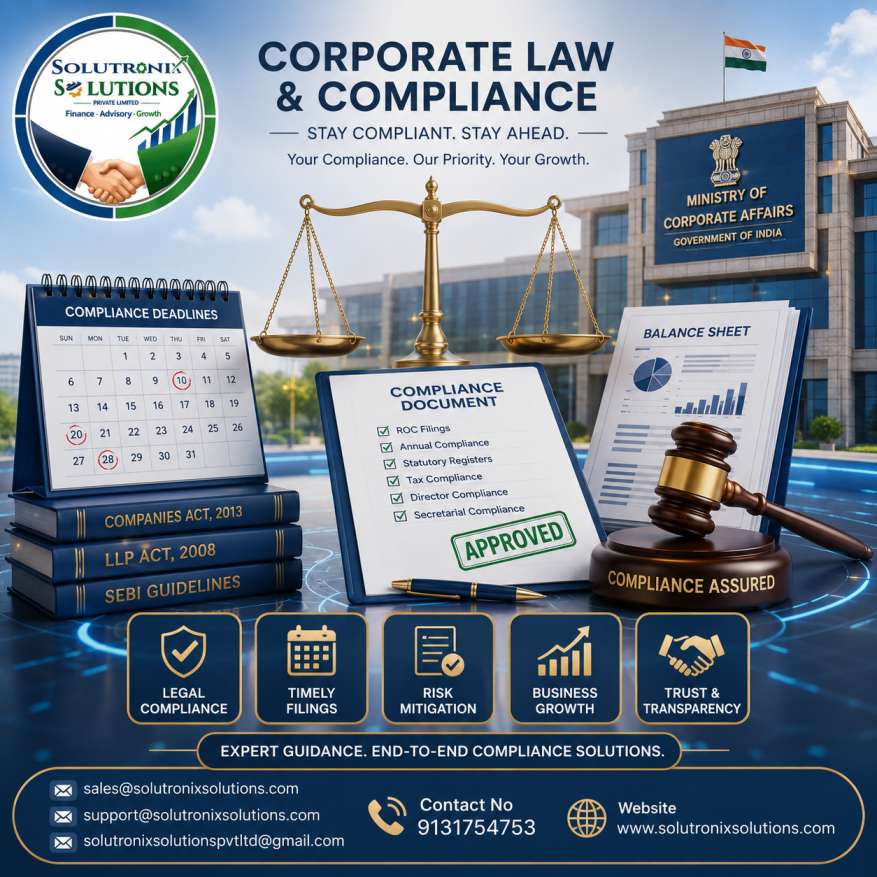
Maintaining strict compliance with the Registrar of Companies (ROC) under the Ministry of Corporate Affairs (MCA) is essential for every registered business in India. Navigating changing regulatory deadlines, procedural mechanics, and penalty structures can be daunting.
Whether operating a Private Limited Company, One Person Company (OPC), or Limited Liability Partnership (LLP), this comprehensive master guide combines statutory annual checklists, procedural steps, event-based obligations, and legal consequences into a single resource.
1. What is ROC Compliance & Why It Matters
ROC compliance refers to the mandatory statutory disclosures, annual financial filings, and event-triggered notifications that every registered corporate entity must submit to the MCA as governed by the Companies Act, 2013 and the Limited Liability Partnership Act, 2008.
Key Enforcement Rules:
- Section 248: Failing to file annual returns for 2 consecutive years empowers the ROC to issue a strike-off notice, revoking the company’s legal status.
- Section 164(2): Defaulting on financial statement or annual return filings for 3 consecutive years leads to automatic Director Disqualification for 5 years.
2. Statutory Meetings & Internal Governance
Before filing financial statements with the ROC, corporate entities must satisfy statutory governance milestones.
A. Board Meeting Compliance (Companies)
- First Meeting: Must be held within 30 days of incorporation.
- Annual Frequency: A minimum of 4 Board Meetings per calendar year (exemptions apply to OPCs and small companies, which require 1 meeting per half-year).
- Maximum Gap: No more than 120 days can elapse between two consecutive meetings.
- Notice & Quorum: Requires at least 7 days’ written notice. Quorum is $1/3^{\text{rd}}$ of total directors or 2 directors, whichever is higher.
B. Annual General Meeting (AGM) Procedure
- Standard Timeline: Must be held on or before September 30th (within 6 months from the end of the financial year).
- First AGM Exception: Newly incorporated companies get up to 9 months from the end of their first financial year.
- Notice: A clear 21-day notice (written or electronic) must be delivered to all shareholders, directors, and statutory auditors.
3. Annual Filing Checklist for Companies & LLPs
A. Company Annual Filings (AOC-4 & MGT-7)
Companies follow a strict sequential filing order: AGM $\rightarrow$ ADT-1 $\rightarrow$ AOC-4 $\rightarrow$ MGT-7.
    [ Conduct AGM ] (By Sept 30)
           │
           ├─► Within 15 Days ──► Form ADT-1 (Auditor Notice)
           │
           ├─► Within 30 Days ──► Form AOC-4 (Financial Statements)
           │
           └─► Within 60 Days ──► Form MGT-7 / MGT-7A (Annual Return)
| Form | Purpose | Target Entity | Standard Due Date |
| ADT-1 | Intimation of Statutory Auditor Appointment | All Companies | Within 15 days of AGM |
| AOC-4 | Balance sheet, P&L, Auditor’s Report, Board Report | All Companies | Within 30 days of AGM |
| AOC-4 XBRL | Financial statements in XBRL taxonomy | Listed & qualifying large entities | Within 30 days of AGM |
| MGT-7 | Detailed Annual Return (Shareholding, Directorships) | Standard Private/Public Co. | Within 60 days of AGM |
| MGT-7A | Simplified Annual Return | OPCs & Small Companies | Within 60 days of AGM / Resolution |
B. LLP Annual Filings (Form 11 & Form 8)
Unlike companies, LLPs operate without AGMs and file operational returns earlier in the compliance cycle:
- LLP Form 11 (Annual Return): Due by May 30th (within 60 days of FY end). Covers management, partner contribution summaries, and turnover details.
- LLP Form 8 (Statement of Account & Solvency): Due by October 30th (within 30 days of 6 months post-FY end). Requires statutory audit only if annual turnover exceeds ₹40 Lakhs or partner contributions exceed ₹25 Lakhs.
4. Director Compliance: DIN KYC, Deactivation & Disqualification
Director governance is tracked via the Director Identification Number (DIN) or Designated Partner Identification Number (DPIN).
Annual DIR-3 KYC Norms
- Deadline: September 30th every year.
- Web vs. E-Form: Repeat filers with no data updates use DIR-3 KYC-Web. First-time filers or those making personal detail changes submit e-Form DIR-3 KYC.
- DIN Deactivation: Failure to complete KYC by September 30th results in immediate DIN deactivation and a ₹5,000 flat late fee per director for reactivation.
- Impact of Deactivation: A director with a deactivated DIN cannot affix their Digital Signature Certificate (DSC) on any MCA form, freezing all corporate filings across all associated entities.
5. Event-Based ROC Compliance Requirements
Beyond annual filings, specific legal actions trigger mandatory event-based filings within strict windows:
        Corporate Action Event
                  │
                  ▼
   ┌──────────────────────────────┐
   │ Check Prescribed Form & Time │
   └──────────────┬───────────────┘
                  │
  ┌───────────────┼───────────────┬───────────────┐
  ▼               ▼               ▼               ▼
DIR-12          PAS-3           SH-7           INC-22
(30 Days)       (30 Days)       (30 Days)      (30 Days)
Director        Share           Capital        Registered
Changes         Allotment       Increase       Office
| Event / Corporate Action | Form | Prescribed Deadline |
| Appointment or Resignation of Director | DIR-12 | Within 30 days of event |
| Allotment of Shares to Investors | PAS-3 | Within 30 days of allotment |
| Increase in Authorised Share Capital | SH-7 | Within 30 days of shareholder resolution |
| Change in Registered Office Address | INC-22 | Within 30 days of change |
| Registration / Modification of Charge (Loans) | CHG-1 | Within 30 days of creation |
| Satisfaction / Discharge of Charge | CHG-4 | Within 30 days of repayment |
| Special Resolutions (MOA/AOA changes, etc.) | MGT-14 | Within 30 days of passing |
| Share Certificate Issuance / Transfer | Form SH-1 / SH-4 | Certificates issued within 2 months of incorporation/allotment; transfers filed within 60 days |
| Half-Yearly MSME Outstanding Dues Return | MSME Form 1 | 30 April (Oct–Mar) & 31 October (Apr–Sep) |
6. Closing or Striking Off a Business (Form STK-2)
If a business becomes dormant or non-operational, formal closure prevents compounding non-compliance penalties.
Voluntary Strike-Off
- Eligibility: Entities that have not commenced operations within 1 year of incorporation or have not carried on active business for 2 consecutive financial years.
- Requirements: All liabilities must be settled, a “Nil Liabilities” certificate obtained from a CA, shareholder approval passed (75% consent), and Form STK-2 submitted along with affidavits (Form STK-4) and indemnity bonds (Form STK-3).
7. Master ROC Penalty & Late Fee Reference Table
The MCA V3 portal auto-calculates late fees from the day after the statutory deadline. Unlike income tax penalties, most ROC late fees have no maximum ceiling.
| Non-Compliance Event | Normal Fee | Late Penalty Structure | Ceiling Limit |
| Late AOC-4 / AOC-4 XBRL | ₹200 – ₹600 | ₹100 per day | No Cap |
| Late MGT-7 / MGT-7A | ₹200 – ₹600 | ₹100 per day | Capped at ₹5,00,000 |
| Late LLP Form 11 / Form 8 | ₹50 – ₹200 | ₹100 per day | No Cap |
| Late DIR-3 KYC / DPIN KYC | Nil | ₹5,000 flat fee | Flat penalty |
| Late ADT-1 / DIR-12 / PAS-3 | ₹200 – ₹600 | ₹100 per day | No Cap |
| Failure to Hold AGM | — | Up to ₹1,00,000 fine + ₹5,000/day | Continuing default penalty |
| Board Meeting Gap > 120 Days | — | ₹25,000 on company; ₹5,000 per director | Direct statutory fine |
⚠️ Financial Reality: Delaying both AOC-4 and MGT-7 for 2 years results in over ₹1,46,000 in automatic late fees before factoring in prosecution or compounding costs under Section 441 of the Companies Act.
Summary Checklist for Corporate Health
To ensure seamless compliance and protect directors from disqualification:
- Maintain regular books and complete statutory audits immediately after the financial year closes.
- Track individual director KYC every September to keep DIN status active.
- Execute sequential filings (AGM $\rightarrow$ ADT-1 $\rightarrow$ AOC-4 $\rightarrow$ MGT-7) systematically.
- Report corporate changes (directorships, share allotments, office address changes) within 30 days of occurrence.
ROCCompliance #MCA #CompaniesAct2013 #PrivateLimitedCompany #LLPCompliance #AOC4 #MGT7 #DIR3KYC #CorporateCompliance #BusinessInIndia #RegistrarOfCompanies #CompanySecretary #CharteredAccountant #StartupCompliance #IndianBusiness #CorporateLaw #CompanyFilings #AnnualReturn #StatutoryAudit #AGM #BoardMeeting #DirectorKYC #Form8 #Form11 #ADT1 #DIR12 #PAS3 #STK2 #BusinessLaw #LegalCompliance #CorporateGovernance #MCAV3 #FINTAX #TaxationIndia #IndianTaxation #DirectorDisqualification #CompanyStrikeOff #ShareAllotment #MSME1 #DPT3 #OPCCompliance #SmallCompany #CorporateIndia #ComplianceCalendar #StartupIndia #LLPAct #CorporateLawyer #LegalUpdatesIndia #BusinessManagement #SMEIndia
ROC compliance, MCA annual filing, AOC 4 filing, MGT 7 form, MGT 7A small company, LLP Form 11, LLP Form 8, DIR 3 KYC due date, ROC filing deadlines, Private limited company compliance, Annual compliance checklist, Companies Act 2013, Registrar of Companies India, Ministry of Corporate Affairs, Section 164 director disqualification, Section 248 company strike off, Annual general meeting procedure, Board meeting compliance, Auditor appointment ADT 1, Late filing penalty ROC, Event based compliance, Form DIR 12, Form PAS 3 share allotment, Form SH 7 capital increase, Form INC 22 registered office, Form STK 2 strike off, DIN deactivation status, DPIN KYC, Financial statement filing, Audited balance sheet MCA, Director identification number, Company annual return, Statutory board meetings 120 day rule, Small company compliance exemptions, OPC annual return filing, MSME Form 1 deadline, Form MGT 14 special resolution, Form DPT 3 return of deposits, Share certificate SH 1, Form CHG 1 charge creation, Statutory audit mandatory, ROC late fees 100 per day, MCA V3 portal filings, Company secretarial checklist, Corporate law compliance, Corporate governance India, Digital signature certificate DSC, Form STK 7 compulsory strike off, Compounding of offences Section 441, Class 3 DSC ROC filing
