








GST & ITR Accounting Records for a Proprietorship Firm: Complete Guide 2026
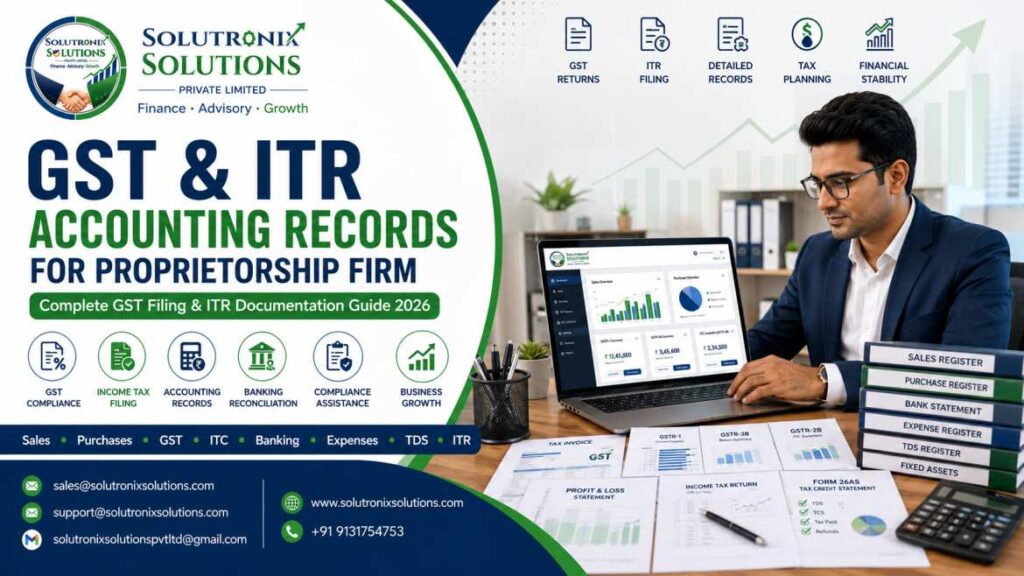
Running a GST-registered proprietorship business involves much more than simply filing a GST return every month and an Income Tax Return once a year. Proper maintenance of sales records, purchase invoices, expenses, bank statements, GST records, ITC data, TDS information, assets, loans, debtors, creditors and capital makes GST compliance and annual ITR filing significantly easier.
For a proprietorship firm, the accounting system should be designed so that the same reliable financial data can be used for GST returns, tax computation, financial statements and annual ITR filing.
Solutronix Solutions Private Limited provides business, tax, GST, compliance and financial advisory assistance to businesses looking to organize their accounting and statutory compliance processes.
What Records Should a GST-Registered Proprietorship Maintain?
A GST-registered proprietorship should ideally maintain the following major records:
| Record / Account | Main Purpose |
|---|---|
| Sales Register | GST output tax and business turnover |
| Purchase Register | Purchases and Input Tax Credit |
| Expense Register | Business expense and profit calculation |
| Bank Book | Bank transactions and reconciliation |
| Cash Book | Cash receipts and payments |
| Debtors Ledger | Customer outstanding amounts |
| Creditors Ledger | Supplier outstanding amounts |
| GST Records | GST return preparation and reconciliation |
| ITC Records | Input Tax Credit verification |
| Fixed Asset Register | Asset tracking and depreciation |
| Loan Register | Principal and interest tracking |
| Stock Register | Inventory management, where applicable |
| TDS Records | TDS compliance and reconciliation |
| Capital Account | Proprietor’s capital and drawings |
| Financial Statements | Profit & Loss and Balance Sheet |
| AIS / TIS / Form 26AS | Income-tax reconciliation |
| ITR Records | Annual Income Tax Return preparation |
The exact books and records required can vary depending on the nature, turnover and tax regime of the business. Income-tax guidance states that books and supporting documents should enable the Assessing Officer to determine the taxpayer’s total income, with specific requirements depending on the applicable provisions.
1. Maintain a Master Business File
Every proprietorship should begin with a Master Business File containing the firm’s basic documents.
Important Documents
- Proprietor’s PAN
- Proprietor’s Aadhaar
- GST Registration Certificate
- Udyam/MSME Registration
- Business address proof
- Rent agreement, if applicable
- Electricity bill
- Current-account details
- FSSAI License, if applicable
- IEC, if applicable
- Shop & Establishment registration, if applicable
- Other business licenses
- Previous year’s ITR
- Previous year’s computation
- Previous year’s financial statements
- Previous year’s GST returns
Recommended folder
01_MASTER_DOCUMENTS
Keeping these documents centrally helps the accountant or tax consultant quickly verify the business profile before preparing GST returns or the annual ITR.
2. Sales Register – The Most Important GST Record
Every business should maintain a detailed Sales Register.
Suggested format
| Date | Invoice No. | Customer | GSTIN | Taxable Value | CGST | SGST | IGST | Total |
|---|
Keep copies of:
- Sales invoices
- Tax invoices
- Bills of supply, where applicable
- Credit notes
- Debit notes
- Delivery challans
- E-invoices, where applicable
- E-way bills, where applicable
- Sales return documents
- Customer receipts
The sales register should ultimately reconcile with the GST returns and the accounting books.
Why is it important?
Your sales data affects:
GST turnover + Output GST + Income-tax turnover + Profit calculation
Therefore, incorrect sales data can create problems across multiple compliances.
3. Purchase Register
A GST business should also maintain a detailed Purchase Register.
Suggested format
| Date | Supplier | GSTIN | Invoice No. | Taxable Value | CGST | SGST | IGST | Total |
|---|
Maintain:
- Purchase invoices
- Supplier bills
- Debit notes
- Credit notes
- Purchase returns
- E-way bills
- Import documents, where applicable
- Payment proofs
- Goods receipt records
The purchase register is particularly important for Input Tax Credit (ITC) reconciliation.
4. GSTR-2B Reconciliation
One of the most important monthly activities is comparing the purchase records with the available GST credit data.
Basic process
Purchase Register
↓
Supplier GST Invoice
↓
GSTR-2B
↓
Eligible ITC
↓
GSTR-3B
The GST Portal uses GSTR-1 and GSTR-3B data and, for FY 2023-24 onward, GSTR-2B data in the system-computed information for GSTR-9.
Therefore, businesses should not simply claim ITC without reviewing the relevant records and eligibility.
5. GST Records
Create a dedicated GST folder for every financial year.
Maintain:
- GSTR-1
- GSTR-3B
- GSTR-2B
- GST challans
- Electronic cash ledger
- Electronic credit ledger
- Electronic liability ledger
- GST payment records
- E-invoices
- E-way bills
- Credit/debit notes
- GST notices
- GST replies
- GST refund records, where applicable
- LUT, where applicable
- GST reconciliation statements
GST Compliance Flow
Sales & Purchases
→ Accounting
→ GSTR-1
→ GSTR-2B Review
→ ITC Reconciliation
→ GSTR-3B
→ GST Payment
→ Books Reconciliation
6. Bank Account and Bank Reconciliation
The business bank statement is one of the most important documents for annual ITR preparation.
Every month download the complete bank statement.
Identify:
- Customer receipts
- Supplier payments
- Business expenses
- Bank charges
- Loan EMI
- Interest
- Owner’s capital introduced
- Owner’s drawings
- Transfers
- Other receipts
Then perform:
Bank Statement vs Books
Bank Reconciliation Statement
This helps identify:
- Missing transactions
- Duplicate entries
- Unrecorded bank charges
- Unrecorded receipts
- Unpresented payments
- Incorrect accounting entries
A separate business bank account also makes the accounting records cleaner and easier to audit/reconcile.
7. Cash Book
If the business receives or makes cash payments, maintain a proper cash book.
Example
Opening Cash
Cash Sales / Receipts
Other Cash Receipts
−
Cash Purchases
−
Business Expenses
−
Cash Withdrawals
=
Closing Cash
The physical cash balance should be reasonably reconcilable with the accounting records.
8. Expense Register
Every business expense should be recorded properly.
Common business expenses
| Expense Category | Examples |
|---|---|
| Office | Rent, electricity, stationery |
| Communication | Internet, telephone |
| Marketing | Google Ads, Meta Ads, printing |
| Professional | CA, lawyer, consultant |
| Technology | Software, hosting, subscriptions |
| Travel | Business travel |
| Staff | Salary and employee expenses |
| Banking | Bank charges |
| Repairs | Equipment/office repairs |
| Insurance | Business-related insurance |
| Logistics | Courier and transportation |
For every expense, maintain:
Date + Vendor + Invoice + Amount + GST + Payment Mode + Business Purpose
This creates a strong supporting trail for accounting and tax computation.
9. Fixed Asset Register
Businesses frequently purchase:
- Computers
- Laptops
- Printers
- Furniture
- Machinery
- Vehicles
- Office equipment
Maintain a Fixed Asset Register.
| Asset | Purchase Date | Cost | GST | Depreciation | WDV |
|---|
The accountant can then use the asset information for applicable depreciation and financial-statement preparation.
10. Debtors / Customer Outstanding
A business should know exactly how much money customers owe it.
Debtor Ledger
| Customer | Opening | Sales | Receipts | Credit Note | Closing |
|---|
At the end of the financial year, calculate:
Total Trade Receivables
This figure can be relevant when preparing financial statements and applicable ITR schedules.
11. Creditors / Supplier Outstanding
Similarly, maintain supplier balances.
Creditor Ledger
| Supplier | Opening | Purchases | Payments | Adjustments | Closing |
|---|
This helps determine the amount payable to suppliers at year-end.
12. Inventory / Stock Records
For trading and manufacturing businesses, maintain:
- Opening stock
- Purchases
- Purchase returns
- Sales
- Sales returns
- Damaged stock
- Closing stock
Basic formula
Opening Stock + Purchases − Cost of Goods Sold = Closing Stock
The exact accounting treatment depends on the business and accounting method.
For service businesses where inventory is not relevant, this section may not apply.
13. Loan Records
If the business has a loan, maintain:
- Loan sanction letter
- Loan agreement
- Loan statement
- EMI schedule
- Principal outstanding
- Interest paid
- Bank payment records
Separate:
Principal repayment
from
Interest expense
during accounting.
14. TDS Records
If the business is liable to deduct TDS, maintain:
- TDS deduction register
- Deductee PAN
- TDS challans
- TDS returns
- Form 16A
- Form 16, where applicable
- TDS reconciliation
At year-end, reconcile:
Books → TDS Returns → Form 26AS → AIS
15. AIS, TIS and Form 26AS
Before preparing the annual ITR, the taxpayer should review the information available through the Income Tax Department.
Download / review:
Form 26AS
AIS – Annual Information Statement
TIS – Taxpayer Information Summary
The Income Tax Department explains that Form 26AS provides tax-related information such as TDS/TCS, while AIS provides broader information including SFT information, tax payments, demand/refund and other reported information.
Reconcile:
| Source | Compare With |
|---|---|
| AIS | Books |
| TIS | Books |
| 26AS | TDS records |
| Bank | Books |
| GST | Sales records |
| TDS Returns | TDS ledger |
This reconciliation can help identify discrepancies before filing the ITR.
16. Proprietor’s Capital Account
A proprietorship should maintain a proper capital account.
Basic structure
Opening Capital
Additional Capital Introduced
Business Profit
−
Drawings
=
Closing Capital
Also identify:
- Personal withdrawals
- Business expenses paid personally
- Personal expenses paid through business account
- Assets introduced by proprietor
- Additional funds introduced by proprietor
This prevents personal and business transactions from becoming mixed together in the accounting records.
17. Profit & Loss Account
At the end of the financial year, prepare the applicable financial statements/accounts.
Basic Profit & Loss structure
Business Revenue
−
Purchases / Direct Costs
−
Business Expenses
−
Depreciation, where applicable
=
Net Business Profit
The final tax treatment depends on the applicable tax provisions and method of taxation.
18. Balance Sheet
Where applicable, prepare a Balance Sheet containing:
Assets
- Fixed assets
- Cash
- Bank
- Debtors
- Inventory
- Advances
- Other assets
Liabilities
- Proprietor’s capital
- Loans
- Creditors
- Outstanding expenses
- Other liabilities
The Income Tax Department’s current ITR guidance includes Balance Sheet and Profit & Loss information in relevant business-return scenarios.
19. Which ITR Should a Proprietorship File?
A proprietorship is generally not a separate legal person from its proprietor for income-tax return filing purposes; the appropriate return depends on the individual’s circumstances and method of taxation.
For AY 2026-27, the Income Tax Department states that:
ITR-3
Generally applies to an individual/HUF having business or professional income who is not eligible for ITR-4.
ITR-4 (Sugam)
May apply to an eligible resident individual/HUF or resident firm other than LLP where business/professional income is computed on a presumptive basis under sections such as 44AD, 44ADA or 44AE, subject to the applicable conditions. The Income Tax Department states that ITR-4 is optional for eligible taxpayers rather than mandatory.
Important: Do not automatically choose ITR-4 simply because the business is a proprietorship. Eligibility should be checked based on the taxpayer’s complete income profile and applicable conditions.
20. GST-to-ITR Reconciliation
This is one of the most important year-end processes.
Turnover Reconciliation
| Particular | Amount |
|---|---|
| Sales as per Books | ₹_____ |
| Sales as per GSTR-1 | ₹_____ |
| Sales as per GSTR-3B | ₹_____ |
| Difference | ₹_____ |
If there is a difference, identify the reason.
Possible reasons can include:
- Credit notes
- Debit notes
- Advances
- Timing differences
- Exempt supplies
- Non-GST items
- Other adjustments
The difference should never simply be ignored.
21. Complete GST + ITR Reconciliation System
A professional accounting process should look like this:
SALES
  ↓
SALES REGISTER
  ↓
GSTR-1
  ↓
GSTR-3B
  ↓
GST RECONCILIATION
  ↓
BOOKS OF ACCOUNT
  ↓
PROFIT & LOSS
  ↓
BALANCE SHEET / APPLICABLE SCHEDULES
  ↓
AIS + TIS + 26AS RECONCILIATION
  ↓
TAX COMPUTATION
  ↓
ITR-3 / ITR-4 AS APPLICABLE
22. Recommended Digital Folder Structure
A professional proprietorship should maintain the following folder structure for each financial year:
CLIENT NAME
│
├── 01_MASTER_DOCUMENTS
│
├── 02_SALES
│   ├── Sales Invoices
│   ├── Credit Notes
│   └── Debit Notes
│
├── 03_PURCHASE
│   ├── Purchase Invoices
│   └── Purchase Returns
│
├── 04_GST
│   ├── GSTR-1
│   ├── GSTR-3B
│   ├── GSTR-2B
│   ├── GST Challans
│   └── GST Reconciliation
│
├── 05_BANK
│   ├── Bank Statements
│   └── Bank Reconciliation
│
├── 06_EXPENSES
│
├── 07_PAYROLL
│
├── 08_TDS
│
├── 09_LOANS
│
├── 10_FIXED_ASSETS
│
├── 11_STOCK
│
├── 12_DEBTORS
│
├── 13_CREDITORS
│
├── 14_INCOME_TAX
│   ├── AIS
│   ├── TIS
│   ├── Form 26AS
│   ├── ITR
│   └── Computation
│
├── 15_FINANCIAL_STATEMENTS
│   ├── Profit & Loss
│   ├── Balance Sheet
│   └── Capital Account
│
└── 16_NOTICES
23. Monthly GST Accounting Checklist
Every month, the business/accountant should ideally check:
- Sales invoices collected
- Purchase invoices collected
- Credit/debit notes recorded
- Bank statement updated
- Cash book updated
- Expenses recorded
- Sales register reconciled
- Purchase register reconciled
- GSTR-2B reviewed
- ITC eligibility checked
- GSTR-1 prepared/reconciled
- GSTR-3B prepared/reconciled
- GST payment verified
- Debtors updated
- Creditors updated
- TDS information updated, where applicable
24. Year-End ITR Checklist
Before filing the annual ITR:
- Final sales figure
- Final purchase figure
- Business expenses
- Bank reconciliation
- Cash balance
- Debtors
- Creditors
- Closing stock, if applicable
- Fixed assets
- Depreciation
- Business loans
- Proprietor’s capital
- Drawings
- TDS records
- Form 26AS
- AIS
- TIS
- GST turnover reconciliation
- GST ITC reconciliation
- Profit & Loss
- Balance Sheet, where applicable
- Tax computation
- Applicable ITR form
- ITR verification
- ITR acknowledgement
25. How Solutronix Solutions Can Help
Managing GST and ITR compliance becomes easier when accounting data is organized throughout the year rather than collected at the last moment.
Solutronix Solutions Private Limited can assist businesses with:
GST Services
- GST Registration
- GST Return Filing
- GSTR-1
- GSTR-3B
- GSTR-2B Reconciliation
- ITC Reconciliation
- GST Compliance Assistance
Income Tax Services
- Business ITR Filing
- ITR-3 / ITR-4 Assistance
- Tax Computation
- Tax Planning
- AIS / TIS / 26AS Reconciliation
- Business Income Tax Guidance
Business Compliance
- MSME / Udyam Registration
- PF & ESIC
- Business Registration
- FSSAI
- IEC
- Other applicable registrations and licenses
Business Advisory
- Accounting process guidance
- Compliance management
- Business documentation
- Financial planning
- Business advisory
26. Why Businesses Should Maintain Records Throughout the Year
Waiting until March or July to collect all documents can create unnecessary problems.
A better approach is:
Record → Reconcile → Review → File
rather than:
Collect everything at year-end → Find mistakes → Reconstruct accounts → File
Proper records help the business:
- Understand profitability
- Track cash flow
- Monitor receivables
- Monitor payables
- Claim eligible GST ITC
- Prepare GST returns accurately
- Prepare the annual ITR
- Respond to notices
- Prepare financial statements
- Apply for business loans
- Demonstrate business performance
- Plan taxes more effectively
Income-tax guidance emphasizes maintaining books and documents that enable computation of total income, while GST law requires registered persons to maintain relevant accounts and records.
27. Record Retention
GST records should not simply be deleted after filing.
Under the CGST Act, registered persons are generally required to retain relevant accounts and records for 72 months from the due date of furnishing the annual return for the relevant year, subject to longer/special retention requirements where appeals, revisions, proceedings or investigations are involved.
Income-tax record-retention requirements can vary according to the applicable provisions and circumstances, so businesses should follow the applicable statutory period rather than adopting a one-size-fits-all approach.
Final Checklist: The Complete GST + ITR Data System
For a GST-registered proprietorship, think of the accounting system as 10 major data blocks:
| No. | Data Block | Main Records |
|---|---|---|
| 1 | Sales | Invoices, credit/debit notes |
| 2 | Purchases | Supplier invoices, ITC |
| 3 | GST | GSTR-1, 3B, 2B, challans |
| 4 | Banking | Statements, reconciliation |
| 5 | Expenses | Bills and payment proofs |
| 6 | Assets | Fixed assets, depreciation |
| 7 | Liabilities | Loans, creditors |
| 8 | People | Salary, PF, ESIC, TDS |
| 9 | Tax | AIS, TIS, 26AS, TDS |
| 10 | Year-End | P&L, Balance Sheet, Capital, ITR |
Conclusion
A GST-registered proprietorship should not treat GST filing and ITR filing as two separate activities. The strongest compliance system is one where sales, purchases, expenses, bank transactions, GST, ITC, TDS, assets, loans, debtors, creditors and proprietor’s capital are recorded throughout the year and then reconciled before preparing the annual tax return.
For AY 2026-27, the Income Tax Department provides ITR-3 for individuals/HUFs with business or professional income who are not eligible for ITR-4, while eligible taxpayers with presumptive business/professional income may use ITR-4 subject to its conditions.
Need help managing GST, accounting records, reconciliation or business ITR filing?
Solutronix Solutions Private Limited
Finance · Advisory · Growth
📧 sales@solutronixsolutions.com
📧 support@solutronixsolutions.com
🌐 www.solutronixsolutions.com
📞 +91 9131754753
Disclaimer: This article is for general educational information and is not a substitute for professional tax or legal advice. GST and income-tax requirements can vary according to the taxpayer, turnover, business activity, accounting method, presumptive-taxation eligibility and other facts. Always verify the applicable law, rules, notifications and current return requirements before filing.
#GST #GSTFiling #GSTRegistration #GSTCompliance #GSTReturn #GSTR1 #GSTR3B #GSTR2B #ITC #ITRFiling #ITR #IncomeTax #IncomeTaxReturn #ITR2026 #Proprietorship #ProprietorshipFirm #BusinessAccounting #Accounting #TaxFiling #TaxPlanning #TaxConsultant #GSTConsultant #ITRConsultant #BusinessCompliance #TaxCompliance #MSME #MSMEIndia #UdyamRegistration #SmallBusiness #SmallBusinessIndia #BusinessOwner #EntrepreneurIndia #IndianBusiness #BusinessFinance #FinancialPlanning #Bookkeeping #BankReconciliation #TDS #Form26AS #AIS #TIS #BusinessTax #IncomeTaxIndia #GSTIndia #TaxTips #BusinessTips #FinanceIndia #SolutronixSolutions #FinanceAdvisory #BusinessAdvisory #GrowthPartner
Keywords: GST accounting records for proprietorship firm, ITR filing records for proprietorship firm, GST and ITR filing for proprietorship, proprietorship firm accounting, GST filing documents, ITR filing documents for business, GST compliance for proprietorship, proprietorship GST return filing, proprietorship ITR filing, business accounting records India, GST accounting checklist, ITR accounting checklist, GST records to maintain, books of accounts for proprietorship, GST purchase register, GST sales register, GST expense register, GST bank reconciliation, GSTR 2B reconciliation, GST ITC reconciliation, GSTR 1 filing, GSTR 3B filing, GST return preparation, business ITR preparation, ITR 3 for proprietorship, ITR 4 for proprietorship, ITR 4 Sugam eligibility, presumptive taxation for proprietorship, Section 44AD proprietorship, Section 44ADA professionals, business expense records, business bank statement accounting, proprietorship profit and loss, proprietorship balance sheet, proprietor capital account, business debtor creditor records, fixed asset register business, TDS records for business, Form 26AS reconciliation, AIS TIS reconciliation, GST turnover reconciliation, GST to ITR reconciliation, annual ITR checklist business, GST compliance checklist 2026, ITR filing checklist 2026, small business tax compliance India, MSME accounting and GST, tax consultant for proprietorship, GST consultant for small business, Solutronix Solutions GST ITR services
