








Complete Guide to ESIC and EPFO Registration in India (2026 Edition)
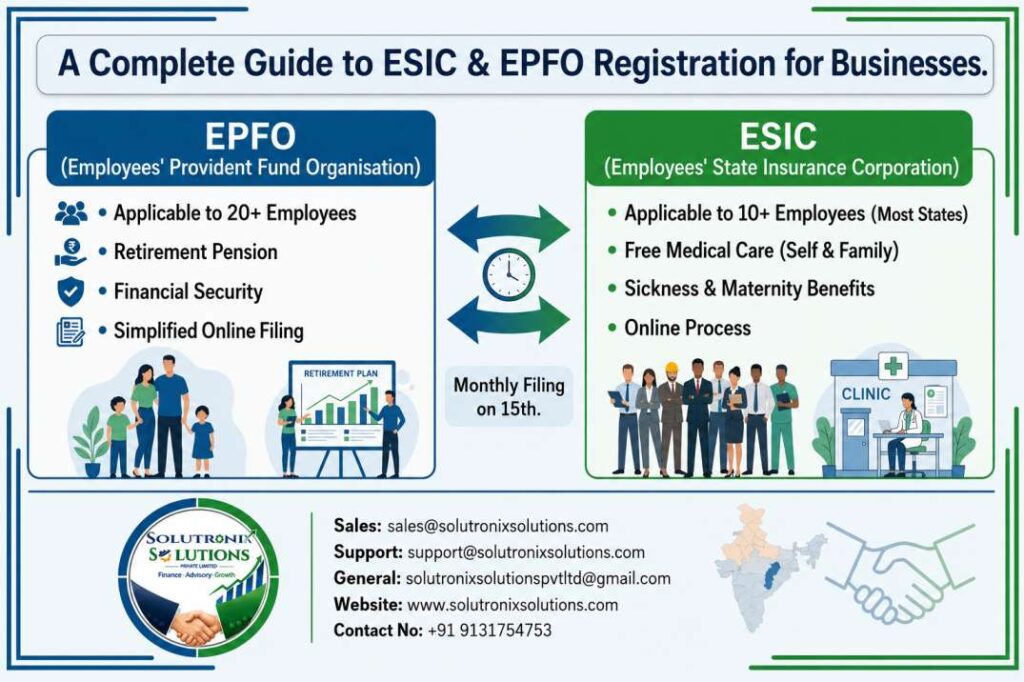
If you are running a growing business in India, managing statutory compliance is just as vital as scaling your sales. Among all labor laws, EPFO (Employees’ Provident Fund Organisation) and ESIC (Employees’ State Insurance Corporation) are the two most critical social security frameworks every employer must understand.
Navigating government portals, eligibility limits, and compliance timelines can quickly become overwhelming. This definitive, step-by-step guide covers everything you need to know about ESIC and EPFO registration in 2026—from eligibility criteria and required documents to online registration procedures and monthly filing rules.
1. Quick Comparison: EPFO vs. ESIC
While both schemes fall under the Ministry of Labour & Employment, they serve distinctly different purposes:
| Feature | EPFO (Employees’ Provident Fund) | ESIC (Employees’ State Insurance) |
| Primary Goal | Long-term retirement savings & pension | Healthcare insurance & disability benefits |
| Governing Law | EPF & MP Act, 1952 | ESI Act, 1948 |
| Employee Headcount | 20 or more employees | 10 or more employees (in most states) |
| Wage Eligibility Cap | ₹15,000 / month (Basic + DA) | ₹21,000 / month (Gross Salary) |
| Employee Share | 12% of Basic + DA | 0.75% of Gross Salary |
| Employer Share | 12% (3.67% PF + 8.33% EPS) + Admin | 3.25% of Gross Salary |
| Monthly Due Date | 15th of the following month | 15th of the following month |
2. Eligibility Criteria for Employers & Employees
EPFO (Employees’ Provident Fund)
- For Employers: Mandatory for any establishment reaching 20 or more employees. Voluntary registration is permitted for establishments with fewer than 20 staff members.
- For Employees: Any employee drawing a Basic Salary + Dearness Allowance (DA) of up to ₹15,000 per month must be enrolled. Employees earning above this threshold can join voluntarily with mutual consent.
Important Note for 2026: Once an establishment registers under EPFO, it remains covered permanently, even if the headcount drops below 20 in the future.
ESIC (Employees’ State Insurance)
- For Employers: Mandatory for non-seasonal factories, shops, and commercial establishments employing 10 or more people (20 in a few specific states).
- For Employees: Applies to all employees whose gross monthly wages are ₹21,000 or less (₹25,000 for employees with physical disabilities).
3. Benefits of Registration
Benefits for Employees
- Medical Protection (ESIC): Free medical care for the employee and their immediate family members from Day 1 of employment.
- Cash Allowances (ESIC): Sickness allowance (70% of wages), maternity benefits (100% of wages for 26 weeks), and permanent disablement pensions.
- Retirement Corpus (EPFO): Compound interest accumulation on PF savings, plus lifetime pension under the Employees’ Pension Scheme (EPS).
- Insurance Protection (EDLI): Life insurance coverage up to ₹7 Lakhs for the employee’s family in the event of death during service.
Benefits for Employers
- 100% Legal Compliance: Avoids severe penalties, interest charges, legal notices, and criminal prosecution.
- Tax Deductions: Employer contributions to PF and ESIC are fully deductible as business expenses under tax laws.
- Higher Employee Retention: Social security coverage builds employer trust and reduces workforce attrition.
4. Checklist of Documents Required
Gathering these documents ahead of time ensures a smooth online registration process:
1.1. Primary Business Documents:Identity & Proof of Business.
- PAN Card of the Business / Entity.
- Certificate of Incorporation (Private Limited/LLP) OR Partnership Deed OR Trade License (Proprietorship).
- GST Registration Certificate.
- Proof of Business Address (Utility Bill, Rent Agreement, or Property Tax receipt).
2.2. Promoter & Bank Details:Verification Information.
- PAN and Aadhaar cards of all Directors, Partners, or the Proprietor.
- Cancelled Cheque or Bank Statement displaying the entity’s bank account details.
- Digital Signature Certificate (DSC) of the Authorized Signatory.
3.3. Employee Master Data:Onboarding Details.
- Total headcount and date of crossing the statutory threshold.
- Aadhaar numbers, PAN numbers, bank account details, and IFSC codes for all employees.
- Salary structure breakdowns (Basic, DA, HRA, and Allowances).
- Nominee details for every covered worker.
5. How to Register Online: Step-by-Step
Registration for both EPFO and ESIC can be completed digitally via integrated portals.
Online EPFO Registration Process
- Access the Unified Portal: Go to the official EPFO Unified Shram Suvidha Portal or the EPFO Establishment Registration Portal (
unifiedportal-emp.epfindia.gov.in). - Create User Credentials: Sign up as a new employer by entering your basic business contact details, email, and mobile number to receive an OTP.
- Fill Out Establishment Details: Input your business name, setup date, ownership structure, primary address, and nature of activity.
- Enter Employment Details: Provide the total number of employees and specify the exact date your headcount reached 20.
- Upload Documents & Sign via DSC: Upload all required establishment proofs and sign the application using the Authorized Signatory’s Digital Signature Certificate (DSC).
- Receive Establishment ID: Upon verification, the portal generates a unique 15-digit EPFO Establishment Code Number.
Online ESIC Registration Process
- Visit the ESIC Portal: Go to the official website (
esic.gov.in) and click on Employer Login -> Sign Up. - Submit Portal Details: Enter your establishment name, state, email ID, mobile number, and primary employer PAN.
- Fill Form-1 (Employer Registration Form): Log in with the credentials sent via email/SMS and enter complete operational, financial, and employee headcount data.
- Pay Initial Contribution: Pay the required initial contribution fee online via net banking, UPI, or credit card.
- Download Form C-11: On successful submission, the system issues Form C-11 (Registration Letter) containing your 17-digit ESIC Code.
6. Understanding Contribution Rates & Calculation Examples
EPFO Contribution Breakdown (12% + 12%)
- Employee Share: 12% deducted from Basic + DA.
- Employer Share:
- 3.67% allocated to the EPF Account.
- 8.33% allocated to the Pension Scheme (EPS) (capped at ₹1,250/month based on the ₹15,000 wage ceiling).
- 0.50% for EDLI (Life Insurance).
- 0.50% for Administrative Charges.
ESIC Contribution Breakdown (4%)
- Employee Share: 0.75% of Gross Salary.
- Employer Share: 3.25% of Gross Salary.
Practical Salary Example
Assume an employee earns a Basic + DA of ₹15,000 and a Gross Salary of ₹20,000:
1. EPFO Calculations (Calculated on Basic = ₹15,000):
   • Employee PF Deduction (12%)      : ₹1,800
   • Employer EPS Share (8.33%)       : ₹1,250
   • Employer EPF Share (3.67%)       : ₹550
   • Employer EDLI + Admin (1.00%)    : ₹150
   -----------------------------------------------
   Total Employer PF Cost             : ₹1,950

2. ESIC Calculations (Calculated on Gross = ₹20,000):
   • Employee ESI Deduction (0.75%)   : ₹150
   • Employer ESI Share (3.25%)       : ₹650
   -----------------------------------------------
   Total Employer ESI Cost            : ₹650
7. Monthly Compliance Calendar & Penalties
To stay compliant, mark these key recurring dates on your calendar:
| Compliance Task | Filing Frequency | Due Date |
| PF ECR Filing & Deposit | Monthly | 15th of the following month |
| ESIC Monthly Deposit | Monthly | 15th of the following month |
| ESIC Half-Yearly Return (Apr–Sep) | Bi-Annually | 11th of November |
| ESIC Half-Yearly Return (Oct–Mar) | Bi-Annually | 11th of May |
Consequences of Non-Compliance
- Delayed Filing Interest: 12% per annum simple interest charged on all delayed contributions under Section 7Q (EPF).
- Penal Damages: Escalating penalties ranging from 5% up to 25% on arrears based on the duration of delay.
- Legal Action: Non-deduction or non-payment of employee contributions constitutes a breach of trust and can attract legal notices or prosecution.
8. Frequently Asked Questions (FAQs)
Q1. Is EPFO registration mandatory for startups with fewer than 20 employees?
No, it is not mandatory until you reach 20 employees. However, startups can opt for voluntary registration to provide social security benefits and attract top talent.
Q2. Can an employee opt out of PF deductions?
If an employee’s Basic Salary is above ₹15,000 at the time of joining their first job, they can choose to opt out by submitting Form 11. However, if they were previously enrolled in PF at a prior workplace, they cannot opt out.
Q3. What happens if an employee’s salary crosses ₹21,000 during the year for ESIC?
If an employee’s gross wage exceeds ₹21,000 mid-way through a contribution period (April–September or October–March), they remain covered by ESIC until the end of that specific 6-month period.
Q4. Can I combine EPFO and ESIC registrations?
Yes. The Government of India’s Shram Suvidha Portal allows businesses to apply for EPFO, ESIC, and LIN (Labour Identification Number) through a single consolidated application.
Final Thoughts
Completing your ESIC and EPFO registration on time ensures your business operates legally while providing essential security to your workforce. Avoid waiting until you receive a compliance notice—audit your employee count today, organize your documents, and complete your registration smoothly online.
