








Importance of Maintaining Books of Accounts

Maintaining proper books of accounts is one of the most important financial practices for any business, whether it is a small proprietorship, partnership firm, LLP, company, startup, or established enterprise. Accurate accounting records help a business understand its financial position, comply with tax laws, control expenses, and make better business decisions.
Many businesses focus primarily on sales and operations and treat accounting as a routine compliance activity. However, well-maintained books of accounts are much more than a record of income and expenses—they provide a clear financial picture of the business and form the foundation for sustainable growth.
What Are Books of Accounts?
Books of accounts are systematic records of a business’s financial transactions. They generally include records of sales, purchases, expenses, receipts, payments, assets, liabilities, loans, bank transactions, and other financial activities.
Depending on the nature and size of the business, accounting records may include:
- Sales and purchase records
- Cash book
- Bank book
- General ledger
- Accounts receivable and payable
- Expense records
- Stock and inventory records
- Fixed asset records
- GST-related records
- Payroll and employee-related records
- Loan and interest records
- Financial statements
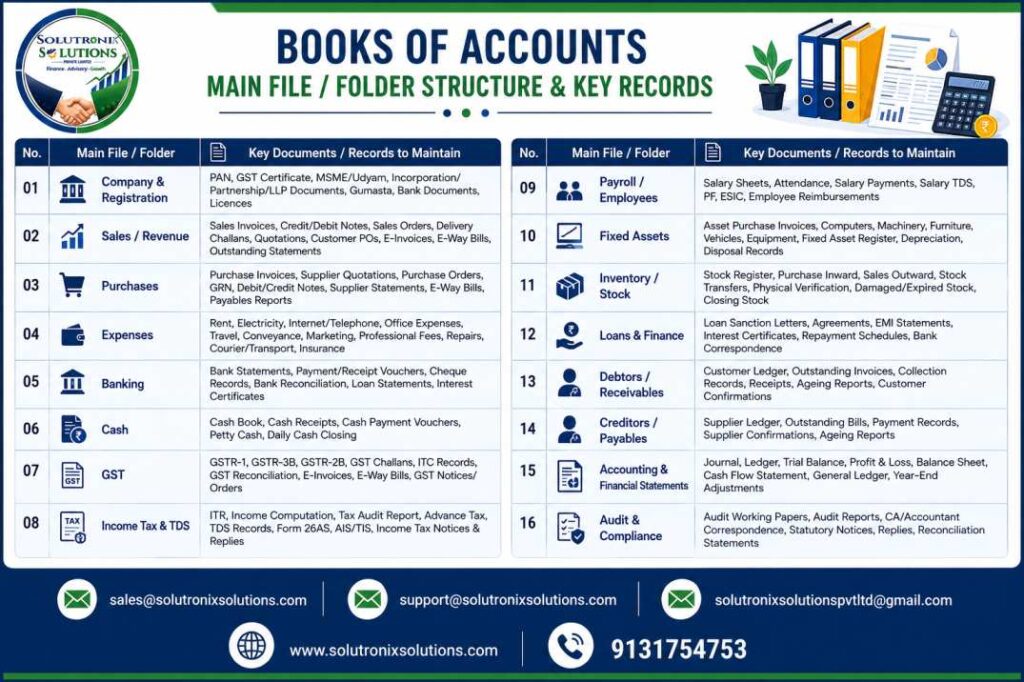
| No. | Main File / Folder | Key Documents / Records to Maintain |
|---|
| 01 | Company & Registration | PAN, GST Certificate, MSME/Udyam, Incorporation/Partnership/LLP Documents, Gumasta, Bank Documents, Licences |
| 02 | Sales / Revenue | Sales Invoices, Credit/Debit Notes, Sales Orders, Delivery Challans, Quotations, Customer POs, E-Invoices, E-Way Bills, Outstanding Statements |
| 03 | Purchases | Purchase Invoices, Supplier Quotations, Purchase Orders, GRN, Debit/Credit Notes, Supplier Statements, E-Way Bills, Payables Reports |
| 04 | Expenses | Rent, Electricity, Internet/Telephone, Office Expenses, Travel, Conveyance, Marketing, Professional Fees, Repairs, Courier/Transport, Insurance |
| 05 | Banking | Bank Statements, Payment/Receipt Vouchers, Cheque Records, Bank Reconciliation, Loan Statements, Interest Certificates |
| 06 | Cash | Cash Book, Cash Receipts, Cash Payment Vouchers, Petty Cash, Daily Cash Closing |
| 07 | GST | GSTR-1, GSTR-3B, GSTR-2B, GST Challans, ITC Records, GST Reconciliation, E-Invoices, E-Way Bills, GST Notices/Orders |
| 08 | Income Tax & TDS | ITR, Income Computation, Tax Audit Report, Advance Tax, TDS Records, Form 26AS, AIS/TIS, Income Tax Notices & Replies |
| 09 | Payroll / Employees | Salary Sheets, Attendance, Salary Payments, Salary TDS, PF, ESIC, Employee Reimbursements |
| 10 | Fixed Assets | Asset Purchase Invoices, Computers, Machinery, Furniture, Vehicles, Equipment, Fixed Asset Register, Depreciation, Disposal Records |
| 11 | Inventory / Stock | Stock Register, Purchase Inward, Sales Outward, Stock Transfers, Physical Verification, Damaged/Expired Stock, Closing Stock |
| 12 | Loans & Finance | Loan Sanction Letters, Agreements, EMI Statements, Interest Certificates, Repayment Schedules, Bank Correspondence |
| 13 | Debtors / Receivables | Customer Ledger, Outstanding Invoices, Collection Records, Receipts, Ageing Reports, Customer Confirmations |
| 14 | Creditors / Payables | Supplier Ledger, Outstanding Bills, Payment Records, Supplier Confirmations, Ageing Reports |
| 15 | Accounting & Financial Statements | Journal, Ledger, Trial Balance, Profit & Loss, Balance Sheet, Cash Flow Statement, General Ledger, Year-End Adjustments |
| 16 | Audit & Compliance | Audit Working Papers, Audit Reports, CA/Accountant Correspondence, Statutory Notices, Replies, Reconciliation Statements |
Why Is Maintaining Books of Accounts Important?
1. Helps Understand the True Financial Position
Proper accounting records show how much the business earns, spends, owns, and owes.
By reviewing financial statements and accounting reports, business owners can understand:
- Revenue generated
- Total operating expenses
- Gross and net profit
- Outstanding receivables
- Outstanding payables
- Cash and bank balances
- Loans and liabilities
- Value of assets
Without accurate records, it can be difficult to determine whether the business is genuinely profitable.
2. Helps in Tax and GST Compliance
Proper books of accounts are essential for preparing tax and GST-related records accurately.
Accounting data can help businesses reconcile sales, purchases, expenses, input tax credit, payments, and other transactions. Maintaining organized records also makes it easier to prepare tax returns and respond to queries from tax authorities.
Businesses should maintain appropriate supporting documents such as invoices, purchase bills, payment records, bank statements, and other relevant documents.
3. Makes Income Tax Return Filing Easier
Income tax calculations are based on the financial activities of the business. Proper books make it easier to determine taxable income and prepare the required financial statements and tax returns.
Instead of searching through bank statements, invoices, and receipts at the end of the financial year, businesses with regular accounting systems can access the required information quickly.
4. Helps Control Unnecessary Expenses
One of the biggest advantages of maintaining accounts is better expense control.
When expenses are categorized and monitored regularly, business owners can identify:
- Unnecessary expenses
- Increasing operating costs
- High-cost suppliers
- Low-margin products
- Excessive administrative expenses
- Recurring expenses that can be reduced
For example, if a business discovers that its transportation expenses have increased significantly over several months, management can investigate the reason and take corrective action.
5. Improves Cash Flow Management
Profit and cash flow are not the same thing.
A business can show a profit on paper but still experience a cash shortage if customers have not paid their outstanding invoices.
Proper accounting helps track:
Money Coming In → Sales → Receivables → Collections
and
Money Going Out → Purchases → Expenses → Payables
This allows business owners to plan payments, collections, working capital, and future expenses more effectively.
6. Helps Track Outstanding Payments
Businesses often sell products or services on credit. If customer receivables are not properly tracked, payments can remain overdue for months.
Accounting systems can help generate customer-wise outstanding reports showing:
- Customer name
- Invoice number
- Invoice date
- Invoice amount
- Amount received
- Balance outstanding
- Due date
- Age of outstanding amount
This makes follow-up and collection management easier.
7. Helps Manage Supplier Payments
The same principle applies to purchases and suppliers.
Businesses can track how much is payable to each supplier and when payments are due. This can help maintain healthy supplier relationships and avoid unnecessary late-payment issues.
8. Supports Better Business Decisions
Business decisions should ideally be based on reliable financial information.
Proper accounting can help answer questions such as:
- Which product generates the highest margin?
- Which customer segment is most profitable?
- Are expenses increasing faster than sales?
- Can the business afford to hire additional employees?
- Is it the right time to purchase new equipment?
- How much working capital is required?
- Can the business take on another loan?
Good accounting therefore becomes a decision-making tool rather than merely a compliance exercise.
9. Helps During Business Loans and Financing
Banks and financial institutions may require financial information when evaluating a business loan or working capital facility.
Depending on the loan and lender, businesses may be asked to provide documents such as:
- Financial statements
- Bank statements
- Income tax returns
- GST records
- Profit and loss statements
- Balance sheets
- Business turnover information
- Receivables and payable details
Well-maintained accounts can make the financial documentation process considerably easier.
10. Useful for Audits and Assessments
Businesses may be required to undergo audits or provide financial records for various statutory or business purposes.
Maintaining organized books along with supporting documents helps the business respond efficiently when financial records are required.
11. Helps Detect Errors and Financial Irregularities
Regular bookkeeping makes it easier to identify unusual transactions, duplicate payments, missing invoices, incorrect entries, and discrepancies between books and bank statements.
Bank reconciliation is particularly useful because it compares accounting records with actual bank transactions.
12. Helps Measure Business Performance
Accounting provides measurable financial indicators that can be monitored over time.
For example:
Revenue Growth = Current Revenue − Previous Revenue
Businesses can also monitor gross margin, net profit margin, operating expenses, receivables, inventory turnover, and other relevant financial metrics.
Comparing these figures month-on-month or year-on-year helps identify trends and potential problems.
Books of Accounts and Business Growth
As a business grows, financial transactions become more complicated. A business may have multiple customers, suppliers, employees, bank accounts, branches, products, loans, and tax obligations.
Manual records that may work for a very small business can become difficult to manage as transaction volumes increase.
A structured accounting system allows the business to establish better financial controls and prepare for expansion.
Common Problems Caused by Poor Accounting
Businesses that do not maintain proper financial records may face problems such as:
- Difficulty determining actual profit
- Missed payments and collections
- Poor cash-flow planning
- Incorrect tax calculations
- Difficulty preparing financial statements
- Difficulty obtaining business finance
- Lack of visibility into expenses
- Difficulty identifying profitable products
- Increased risk of accounting errors
- Last-minute compliance pressure
These problems can ultimately affect business growth and profitability.
Best Practices for Maintaining Books of Accounts
Businesses should consider adopting the following practices:
Record Transactions Regularly
Do not wait until the end of the month or financial year. Record transactions regularly so that financial information remains current.
Maintain Supporting Documents
Keep invoices, receipts, bank statements, purchase documents, expense bills, and other relevant records in an organized manner.
Reconcile Bank Accounts
Regular bank reconciliation helps identify differences between accounting records and actual bank transactions.
Monitor Receivables and Payables
Track customer collections and supplier payments systematically.
Separate Business and Personal Transactions
Business owners should avoid mixing personal and business expenses wherever possible. Maintaining separate business banking and accounting records provides greater financial clarity.
Review Financial Reports Regularly
Management should periodically review reports such as:
- Profit & Loss Statement
- Balance Sheet
- Cash Flow Statement
- Receivables Ageing
- Payables Ageing
- Expense Reports
- Sales Reports
Conclusion
Maintaining books of accounts is not simply a compliance requirement—it is an essential financial management practice. Accurate accounting records help businesses understand their financial health, manage cash flow, control expenses, meet tax obligations, obtain financing, and make informed decisions.
Whether you operate a small business or a growing company, maintaining accurate and up-to-date books can provide the financial clarity needed to manage today’s operations and plan tomorrow’s growth.
In simple words: If you don’t know your numbers, you don’t truly know your business.
Keywords
Maintaining books of accounts, Books of accounts, Accounting for business, Business accounting, Importance of bookkeeping, Accounting records, Financial record keeping, Business financial management, Bookkeeping services, Accounting compliance
SEO Keywords
Importance of maintaining books of accounts, Maintaining books of accounts, Books of accounts, Importance of bookkeeping, Business accounting, Accounting for small business, Bookkeeping for business, Business financial records, Accounting records, Financial record keeping, Importance of accounting, Benefits of bookkeeping, Business bookkeeping, Proper books of accounts, Accounting compliance, GST accounting, GST bookkeeping, Income tax accounting, Tax compliance for business, Business financial management, Cash flow management, Business expense management, Profit and loss statement, Balance sheet, Business accounting records, Accounts management, Financial accounting, Small business accounting, Accounting system for business, Maintain business accounts, Accounting and bookkeeping, Importance of financial records, Business tax records, Accounting documentation, Financial reporting, Business expense tracking, Accounts receivable management, Accounts payable management, Business cash flow, Accounting for startups, Accounting for MSMEs, MSME accounting, GST compliance, Income tax return preparation, Business financial planning, Accounting best practices, Bookkeeping best practices, Business financial control, Accurate accounting records, Professional accounting services
Hashtags
#Bookkeeping, #Accounting, #BusinessAccounting, #BooksOfAccounts, #BookkeepingServices, #AccountingServices, #FinancialManagement, #BusinessFinance, #FinancialRecords, #BusinessManagement, #SmallBusiness, #MSME, #MSMEBusiness, #GST, #GSTCompliance, #IncomeTax, #TaxCompliance, #TaxPlanning, #BusinessGrowth, #CashFlow, #CashFlowManagement, #FinancialPlanning, #FinancialReporting, #ProfitAndLoss, #BalanceSheet, #BusinessTips, #Entrepreneurship, #Entrepreneur, #StartupIndia, #IndianBusiness, #AccountingTips, #BookkeepingTips, #FinanceTips, #BusinessTipsIndia, #AccountingIndia, #GSTIndia, #TaxIndia, #MSMEIndia, #BusinessFinanceIndia, #FinancialPlanningIndia, #AccountsManagement, #BusinessAccountingIndia, #AccountingRecords, #FinancialControl, #BusinessStrategy, #BusinessSuccess, #BusinessCompliance, #TaxFiling, #ITRFiling, #BusinessGrowthTips
