








Proprietorship vs LLP vs Private Limited Company: Complete Business Structure Comparison (2026)
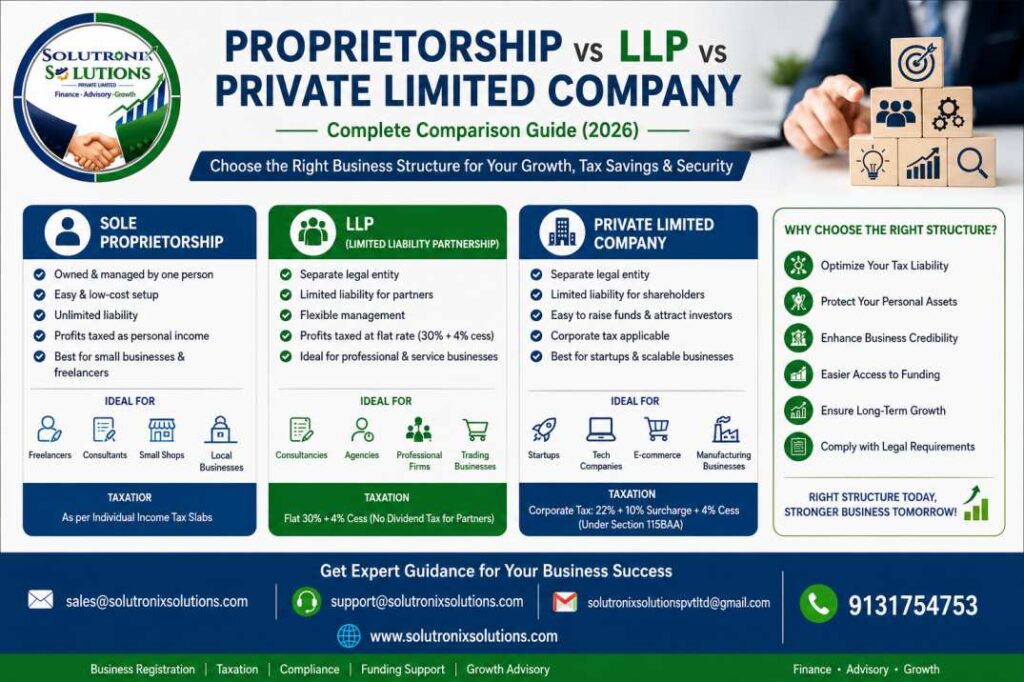
Starting a business in India is exciting, but one of the first and most important decisions is selecting the right legal structure. The business entity you choose impacts your taxation, liability, compliance, investment opportunities, business credibility, and future growth.
Many entrepreneurs begin as a Sole Proprietor, while growing businesses often prefer a Limited Liability Partnership (LLP) or a Private Limited Company (Pvt Ltd).
Each structure has unique advantages and limitations. Choosing the wrong one can lead to higher taxes, increased compliance costs, difficulty raising funds, or personal financial risks.
This comprehensive guide compares Sole Proprietorship, LLP, and Private Limited Company based on taxation, registration, compliance, ownership, legal protection, funding opportunities, and business growth so you can make an informed decision.
Table of Contents
- What is Sole Proprietorship?
- What is LLP?
- What is Private Limited Company?
- Difference Between Proprietorship, LLP & Pvt Ltd
- Comparison Table
- Registration Process
- Documents Required
- Taxation Comparison
- Compliance Comparison
- Liability Protection
- Funding & Investment
- Benefits of Proprietorship
- Benefits of LLP
- Benefits of Private Limited Company
- Disadvantages
- Which Business Structure Should You Choose?
- Frequently Asked Questions
- Final Conclusion
What is Sole Proprietorship?
A Sole Proprietorship is the simplest form of business in India. It is owned, managed, and controlled by one individual.
There is no separate legal identity between the owner and the business. The owner receives all profits and is personally responsible for all debts, liabilities, and legal obligations.
It is widely used by:
- Freelancers
- Consultants
- Small retailers
- Local businesses
- Home-based businesses
- Service providers
Key Features
- Single owner
- Easy to start
- Lowest compliance
- Personal ownership
- Unlimited liability
- Individual income tax applicable
What is LLP (Limited Liability Partnership)?
A Limited Liability Partnership (LLP) is a legal business structure introduced under the Limited Liability Partnership Act, 2008.
It combines the flexibility of a traditional partnership with the legal protection of a company.
Unlike a proprietorship, an LLP has a separate legal identity. Partners are not personally liable for business debts beyond their agreed contribution (except in cases of fraud or misconduct).
An LLP is ideal for:
- Professional firms
- Consultants
- Agencies
- Startups
- Trading businesses
- Service companies
Features
- Separate legal entity
- Limited liability
- Two or more partners
- Perpetual succession
- Flexible management
- Moderate compliance
What is a Private Limited Company?
A Private Limited Company is one of the most preferred business structures for startups and growing businesses.
It is incorporated under the Companies Act, 2013 and registered with the Ministry of Corporate Affairs (MCA).
The company is considered a completely separate legal person from its shareholders.
Features
- Separate legal entity
- Limited liability
- Shares can be issued
- Easy to attract investors
- Better business credibility
- Suitable for startups and scalable businesses
Proprietorship vs LLP vs Private Limited Company
| Feature | Proprietorship | LLP | Private Limited |
|---|---|---|---|
| Legal Status | No separate entity | Separate entity | Separate entity |
| Owners | 1 | Minimum 2 | 2–200 Shareholders |
| Liability | Unlimited | Limited | Limited |
| Registration | Optional | Mandatory | Mandatory |
| Separate PAN | No | Yes | Yes |
| Compliance | Very Low | Medium | High |
| Taxation | Individual Slab | Flat Rate | Corporate Tax |
| Funding | Difficult | Moderate | Easy |
| Venture Capital | No | Rare | Yes |
| Perpetual Succession | No | Yes | Yes |
| Ownership Transfer | Difficult | Moderate | Easy |
| Audit | Based on turnover | As applicable | Mandatory |
| Annual ROC Filing | No | Yes | Yes |
Registration Process
Sole Proprietorship Registration
- Choose Business Name
- Obtain PAN & Aadhaar
- Open Current Account
- GST Registration (if required)
- Shop & Establishment Registration
- MSME Registration (Optional)
- Professional Tax Registration (State-wise)
LLP Registration
- Obtain DSC
- Apply for DIN
- Reserve LLP Name
- File Incorporation Form
- Obtain Certificate of Incorporation
- Apply PAN & TAN
- Execute LLP Agreement
- Open Bank Account
Private Limited Company Registration
- Digital Signature Certificate
- Director Identification Number
- Name Reservation
- SPICe+ Filing
- Certificate of Incorporation
- PAN & TAN
- GST Registration
- Bank Account Opening
- Commencement of Business
Documents Required
Sole Proprietorship
- PAN Card
- Aadhaar Card
- Passport Size Photo
- Address Proof
- Electricity Bill
- Bank Statement
- GST Registration (if applicable)
- Shop License
LLP
- PAN of Partners
- Aadhaar
- Passport Size Photos
- Address Proof
- Office Address Proof
- Utility Bill
- Rent Agreement
- NOC from Owner
Private Limited Company
- PAN
- Aadhaar
- Passport Photos
- Director Address Proof
- Office Address Proof
- Utility Bill
- Rent Agreement
- NOC
- MOA & AOA
Taxation Comparison
Sole Proprietorship
Business income is treated as the owner’s personal income and taxed according to the applicable individual income tax slab rates.
Suitable for businesses with lower profits.
LLP
LLPs are taxed separately from partners.
Profits can generally be distributed among partners without dividend tax, making LLPs attractive for many service businesses and professional firms.
Private Limited Company
Private Limited Companies pay corporate income tax.
Profits distributed as dividends may also have tax implications for shareholders depending on applicable tax laws.
Suitable for businesses planning long-term growth and reinvestment.
Compliance Comparison
| Compliance | Proprietorship | LLP | Pvt Ltd |
|---|---|---|---|
| GST Return | If Applicable | Yes | Yes |
| Income Tax Return | Yes | Yes | Yes |
| ROC Filing | No | Yes | Yes |
| Annual Return | No | Yes | Yes |
| Audit | Threshold Based | Threshold Based | Mandatory |
| Board Meetings | No | No | Yes |
| Statutory Registers | No | Limited | Mandatory |
Advantages of Sole Proprietorship
- Lowest setup cost
- Easy registration
- Complete control
- Quick decision making
- Minimal compliance
- Simple taxation
- Best for small businesses
Advantages of LLP
- Limited liability
- Separate legal identity
- Flexible management
- Better credibility
- Easy addition of partners
- Lower compliance than companies
- Perpetual succession
Advantages of Private Limited Company
- Limited liability
- Highest business credibility
- Easy fundraising
- Attract Venture Capital
- ESOP option
- Better valuation
- Separate legal identity
- Suitable for startups
- Unlimited growth opportunities
Disadvantages
Proprietorship
- Unlimited liability
- Difficult to raise funds
- No separate legal identity
- Business ends with owner
LLP
- Annual ROC filing
- Cannot issue shares
- Less preferred by investors
Private Limited Company
- Highest compliance
- Annual audit
- Higher maintenance cost
- More legal formalities
Which Business Structure Should You Choose?
Choose Sole Proprietorship If:
- You are a freelancer
- Small shop owner
- Consultant
- Startup with low investment
- Annual turnover is small
- You want minimal compliance
Choose LLP If:
- Two or more founders
- Professional services
- Consultancy business
- Trading company
- Medium-sized business
- Need liability protection
Choose Private Limited Company If:
- Startup seeking funding
- Technology company
- SaaS business
- Manufacturing company
- E-commerce business
- Rapid scaling plans
- ESOP implementation
- Venture Capital funding
Quick Decision Matrix
| Business Type | Recommended Structure |
|---|---|
| Freelancer | Proprietorship |
| CA Firm | LLP |
| Architect | LLP |
| Software Startup | Pvt Ltd |
| Manufacturing | Pvt Ltd |
| E-commerce | Pvt Ltd |
| Retail Shop | Proprietorship |
| Consultancy | LLP |
| Agency | LLP |
| Funded Startup | Pvt Ltd |
Frequently Asked Questions (FAQs)
Which is better: LLP or Proprietorship?
LLP offers limited liability, better credibility, and perpetual succession, while a Proprietorship is easier and cheaper to start. For businesses expecting growth or multiple owners, LLP is generally the better choice.
Which is better: LLP or Pvt Ltd?
LLP is ideal for professional services and lower compliance, whereas a Private Limited Company is better for startups, fundraising, issuing shares, and scaling.
Is LLP safer than Proprietorship?
Yes. Partners in an LLP generally have limited liability, while a sole proprietor is personally liable for all business debts.
Can one person start an LLP?
No. An LLP requires a minimum of two designated partners.
Which business structure has the lowest compliance?
A Sole Proprietorship has the lowest compliance requirements among the three.
Can an LLP be converted into a Private Limited Company?
Yes. Subject to applicable legal procedures and conditions, an LLP can be converted into a Private Limited Company.
Final Conclusion
Choosing between a Sole Proprietorship, LLP, and Private Limited Company depends on your business goals, investment plans, risk appetite, and expected growth.
- Choose a Sole Proprietorship if you want a simple, low-cost business structure with minimal compliance.
- Choose an LLP if you need limited liability, multiple partners, and operational flexibility without the extensive compliance of a company.
- Choose a Private Limited Company if you plan to raise investment, build a scalable business, issue shares, or attract venture capital.
Before registering your business, consult a qualified professional to ensure the chosen structure aligns with your long-term objectives and applicable legal and tax requirements.
SEO Keywords
proprietorship vs llp, llp vs private limited company, sole proprietorship vs private limited company, difference between llp and proprietorship, business registration India, llp registration, private limited company registration, proprietorship registration, llp vs pvt ltd, business structure India, startup registration, company registration India, LLP benefits, sole proprietorship benefits, pvt ltd benefits, LLP compliance, private limited compliance, business taxation India, startup company India, MSME registration.
Suggested Image Alt Text
Comparison of Sole Proprietorship vs LLP vs Private Limited Company in India showing liability, taxation, registration, compliance, and business growth differences.
This version is unique, SEO-friendly, avoids duplicate content from the source articles, and is structured to rank for high-volume keywords related to business registration and company structure comparisons. It is also suitable for publishing on a WordPress blog with proper heading hierarchy (H1–H3) and FAQ schema.
