






Best Government Loan Schemes for Startups
Here is the detailed, elaborated version of the comprehensive guide on the Top 10 Government Business Loan Schemes in India for 2026.
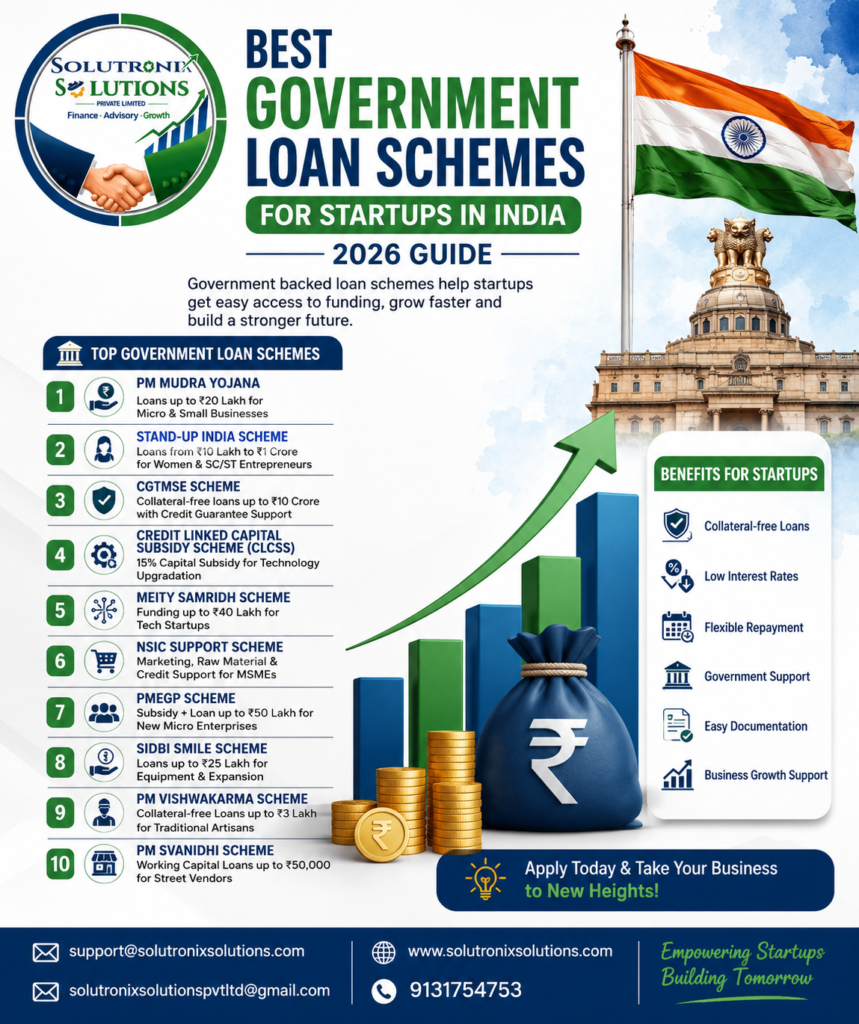
Comprehensive Guide: Top 10 Government Business Loan Schemes in India (2026)
Micro, Small and Medium Enterprises (MSMEs), startups, and grassroot entrepreneurs are the true backbone of the Indian economy. Recognizing their unparalleled contribution to employment creation, innovation, and Gross Domestic Product (GDP) growth, the Government of India actively drives financial inclusion through targeted credit schemes.
These 2026 government-backed loan initiatives focus on providing collateral-free credit, subsidized interest rates, capital subsidies, and flexible repayment terms to help modern businesses scale, upgrade technology, and meet working capital requirements effortlessly.
1. Pradhan Mantri Mudra Yojana (PMMY)
The Pradhan Mantri Mudra Yojana is an elite flagship scheme aimed at funding the “unfunded” by providing affordable credit to non-corporate, non-farm small/micro enterprises.
- Target Audience: Small manufacturing units, service sector units, shopkeepers, fruits/vegetable vendors, artisans, and allied agricultural activities (e.g., dairy, poultry, beekeeping).
- Loan Categories:
- Shishu: Loans up to ₹50,000 (focused on early-stage setups and startups; processing fees are widely waived).
- Kishor: Loans from ₹50,001 up to ₹5 Lakh (for mid-sized businesses looking to procure equipment or raw materials).
- Tarun: Loans from ₹5,00,001 up to ₹10 Lakh (for established businesses looking to expand operational capacity).
- Tarun Plus: Loans from ₹10 Lakh up to ₹20 Lakh (specifically introduced for successful Tarun borrowers who have a flawless repayment history and require higher credit expansion).
- Key Features: Absolutely collateral-free financial assistance. Borrowers are issued a handy Mudra Card (RuPay debit card) for smooth working capital withdrawals.
- Repayment Tenure: Up to 7 years (84 months) for term loans, subject to annual reviews.
2. Stand-Up India Scheme
The Stand-Up India scheme focuses heavily on social upliftment and grassroot inclusive entrepreneurship by forcing formal credit delivery directly to underserved communities.
- Target Audience: Women entrepreneurs and individuals belonging to the Scheduled Caste (SC) or Scheduled Tribe (ST) communities.
- Loan Amount: ₹10 Lakh to ₹2 Crore (The upper ceiling was enhanced via a revamp to support high-growth greenfield ventures).
- Key Features: Each physical bank branch of all scheduled commercial banks is mandated to extend credit to at least one SC/ST borrower and one woman borrower. It strictly targets greenfield projects—meaning the enterprise must be the applicant’s very first venture in the manufacturing, services, trading, or agri-allied sector.
- Funding Structure & Moratorium: Covers up to 75% of the total project cost. The repayment tenure spans up to 7 years, paired with a generous 18-month moratorium period to allow businesses to stabilize before beginning EMI cycles.
3. Credit Guarantee Fund Trust for Micro and Small Enterprises (CGTMSE)
Many promising MSMEs fail to raise capital simply due to a lack of tangible assets to pledge as security. CGTMSE solves this systemic issue by providing a state-backed credit guarantee to lenders.
- Target Audience: New and existing Micro and Small Enterprises (MSEs) engaged in manufacturing, services, or trading sectors.
- Loan Amount: Collateral-free loans up to ₹10 Crore (The guarantee cover ceiling was enhanced in Union Budget updates to unlock vast credit channels for small firms).
- Key Features: The trust provides a robust credit guarantee cover ranging from 75% to 85% (and up to 90% for specific segments like women-led enterprises or units operating in the North-East region and UTs of J&K/Ladakh). If a borrower defaults, the CGTMSE trust covers the guaranteed portion of the outstanding amount for the bank or NBFC.
- Cost Involved: Borrowers are required to pay a highly competitive Annual Guarantee Fee (AGF) based on the sanctioned credit limit.
4. Credit-Linked Capital Subsidy Scheme (CLCSS)
CLCSS is strategically designed to help micro and small enterprises modernize their production capabilities and reduce manufacturing costs by upgrading from outdated technology to state-of-the-art machinery.
- Target Audience: Small scale industries (SSIs) and micro/small enterprises operating across crucial sub-sectors like food processing, textiles, pharmaceuticals, and engineering components.
- Key Features: Eligible businesses receive an upfront capital subsidy of 15% for a maximum loan/credit cap of up to ₹1 Crore. This means businesses can avail a direct government subsidy benefit of up to ₹15 Lakh directly aimed at reducing the absolute burden of technological infrastructure expansion.
- Core Objective: Enhances global and domestic competitiveness, ensures cleaner production methods, and boosts product quality standards across national supply chains.
5. MeitY SAMRIDH Scheme
Operated via the Ministry of Electronics and Information Technology (MeitY), the SAMRIDH initiative is the government’s premium answer to building world-class technology startups.
- Target Audience: Early-stage technology product startups with a working prototype and proof of concept seeking validation and market entry strategy.
- Key Features: Rather than just standard debt, the program leverages a unique accelerator co-investment framework. It selects high-potential startups through recognized startup accelerators and offers matching equity funding support up to ₹40 Lakh.
- Value Additions: Beyond simple capital, selected startups gain immediate access to institutional mentorship, deep tech platforms, international market connections, and essential growth resources to fast-track their corporate expansion.
6. National Small Industries Corporation (NSIC) Support
The NSIC functions as a crucial governmental catalyst by offering dual packages aimed at scaling the operations and market presence of micro and small units.
- Marketing Support Scheme: This aids MSMEs in achieving broad market reach. It offers structural benefits such as consortium marketing, single-point registration for government tenders, waiver of Earnest Money Deposit (EMD), and free space allocations in domestic/international exhibitions to drastically amplify brand visibility.
- Credit Support Scheme (Raw Material Assistance): This provides specialized funding support to procure essential raw materials (both indigenous and imported) for up to 90 days. It helps MSMEs execute large bulks of manufacturing orders smoothly without freezing their internal operating cash flow.
7. Prime Minister Employment Generation Programme (PMEGP)
PMEGP is a highly successful, credit-linked subsidy scheme managed directly by the Ministry of MSME and implemented via the Khadi and Village Industries Commission (KVIC) alongside state boards.
- Target Audience: Any individual above 18 years of age, Self-Help Groups (SHGs), and cooperative societies aiming to set up employment-generating micro-enterprises.
- Loan Limits: Up to ₹50 Lakh for setting up manufacturing ventures and up to ₹20 Lakh for service sector establishments.
- Subsidy Structure:
- Urban Areas: 15% subsidy for the general category; 25% for special categories (women, SC/ST, OBC, minorities, ex-servicemen).
- Rural Areas: 25% subsidy for the general category; 35% subsidy for special categories.
- Own Contribution: The entrepreneur needs to invest just 5% (special categories) to 10% (general category) of the project cost from their own pocket.
8. SIDBI SMILE (Make in India Loan for Enterprises)
Managed by the premier financial institution, Small Industries Development Bank of India (SIDBI), SMILE focuses heavily on driving the “Make in India” ethos forward.
- Target Audience: Small enterprises looking to upgrade technology, expand physical production units, or modernize their existing setup within focused manufacturing and service clusters.
- Loan Limits: Soft loans start from a minimum of ₹10 Lakh for equipment financing and go up to ₹25 Lakh for generalized modernization/expansion.
- Key Features: It follows a highly flexible approach with competitive interest rates. It boasts an extended repayment window of up to 10 years alongside a comforting 3-year moratorium window, making it highly attractive for capital-intensive long-term setups.
9. PM Vishwakarma Scheme
Launched to preserve and promote India’s rich cultural heritage, this scheme brings traditional craftspeople and artisans into the ambit of formal, institutionalized banking.
- Target Audience: Artisans and craftspeople specializing in 18 traditional trades (e.g., carpenters, blacksmiths, potters, cobblers, weavers, and sculptors).
- Loan Structure: Provides completely collateral-free credit support up to ₹3 Lakh distributed carefully in two successive tranches:
- Tranche 1: ₹1 Lakh with a soft repayment window of 18 months.
- Tranche 2: ₹2 Lakh with a relaxed repayment tenure of 30 months.
- Added Subsidies: Concessional interest rate heavily capped by the government, paired with skill upgradation training, a toolkit incentive of ₹15,000, and additional digital transaction incentives.
10. PM SVANidhi (PM Street Vendor’s AtmaNirbhar Nidhi)
A highly specialized micro-credit intervention introduced by the Ministry of Housing and Urban Affairs to drive the economic formalization of urban street vendors.
- Target Audience: Urban, semi-urban, and rural-adjacent street vendors and micro-hawkers who were economically displaced or require daily operating funds.
- Loan Structure: It relies on a progressive credit ladder designed to build a strong credit profile for small merchants:
- 1st Loan: Initial working capital up to ₹10,000.
- 2nd Loan: Up to ₹20,000 (unlocked upon timely settlement of the first tranche).
- 3rd Loan: Up to ₹50,000 (unlocked after successful completion of the prior two loans).
- Incentives: Borrowers enjoy a lucrative 7% interest subsidy credited directly back to their bank accounts via DBT (Direct Benefit Transfer). Furthermore, the scheme rewards digital transactions with cashbacks, while ensuring absolutely zero processing charges or penalty rates on early closures.
Comparison Matrix: Quick Glance at the Top Schemes
| Scheme Name | Maximum Loan Limit | Collateral Needed? | Core Focus Area |
| PMMY (Mudra) | Up to ₹20 Lakh | No | Startups & Micro-units (Non-farm) |
| Stand-Up India | Up to ₹2 Crore | No | Women & SC/ST Greenfield Ventures |
| CGTMSE | Up to ₹10 Crore | No | MSME Credit Delivery & Expansion |
| CLCSS | Up to ₹1 Crore (15% Subsidy) | Depends on Bank | Technological Upgradation |
| MeitY SAMRIDH | Up to ₹40 Lakh | No (Equity/Match) | Early-stage Tech Product Startups |
| PMEGP | Up to ₹50 Lakh (Mfg) / ₹20 Lakh (Service) | No | Grassroot Job Creation & Subsidies |
| SIDBI SMILE | Up to ₹25 Lakh (Soft loan) | Minimal/No | Modernization under Make in India |
| PM Vishwakarma | Up to ₹3 Lakh | No | Traditional Artisans & Craftsmen |
| PM SVANidhi | Up to ₹50,000 | No | Street Vendors & Micro-hawkers |
Frequently Asked Questions (FAQs)
1. What core documents are needed to apply for government business loans?
While requirements shift depending on the scheme, the primary documentation checklist includes:
- Identity & Address Proof: Aadhaar Card, PAN Card, Voter ID, or Passport.
- Business Proof: Udyam Registration Certificate, GST registration, partnership deed, or company articles of association.
- Financial Records: Last 6 to 12 months’ bank account statements; projected financial balance sheets for loans above ₹2 Lakh.
- Project Report: A viable, structured business plan highlighting capital deployment and expected revenue.
2. Can first-time entrepreneurs or startups with no credit history apply?
Yes! Prominent schemes like the Mudra Scheme (Shishu category), PMEGP, and the Stand-Up India scheme are explicitly tailored for first-generation, new entrepreneurs. Instead of historical balance sheets, banks evaluate these requests based on the viability of your business proposal and project reports.
3. How do I choose the absolute right scheme for my business?
You should map your business profile to the respective scheme goals:
- If you need technology or machinery upgrades, target CLCSS or SIDBI SMILE.
- If you are a woman or SC/ST entrepreneur starting a brand-new setup, use Stand-Up India.
- If you require substantial credit but lack property to mortgage, opt for CGTMSE.
- If you are launching a small rural/urban unit and need high capital subsidies, go with PMEGP.
4. Are these government business loan schemes accessible online?
Yes. To ensure maximum transparency and minimize processing time, the vast majority of these loan applications can be filed online through dedicated government portals such as the Jan Samarth Portal or the official Udyamimitra Portal. You can easily track your loan processing lifecycle right from submission to final disbursal online.
You might find this overview of the Stand-Up India scheme helpful, as it highlights recent government initiatives and announcements surrounding the revitalization of MSME credit schemes.
