








Freelancer Income Tax Guide 2026: ITR Filing, GST, TDS & Advance Tax
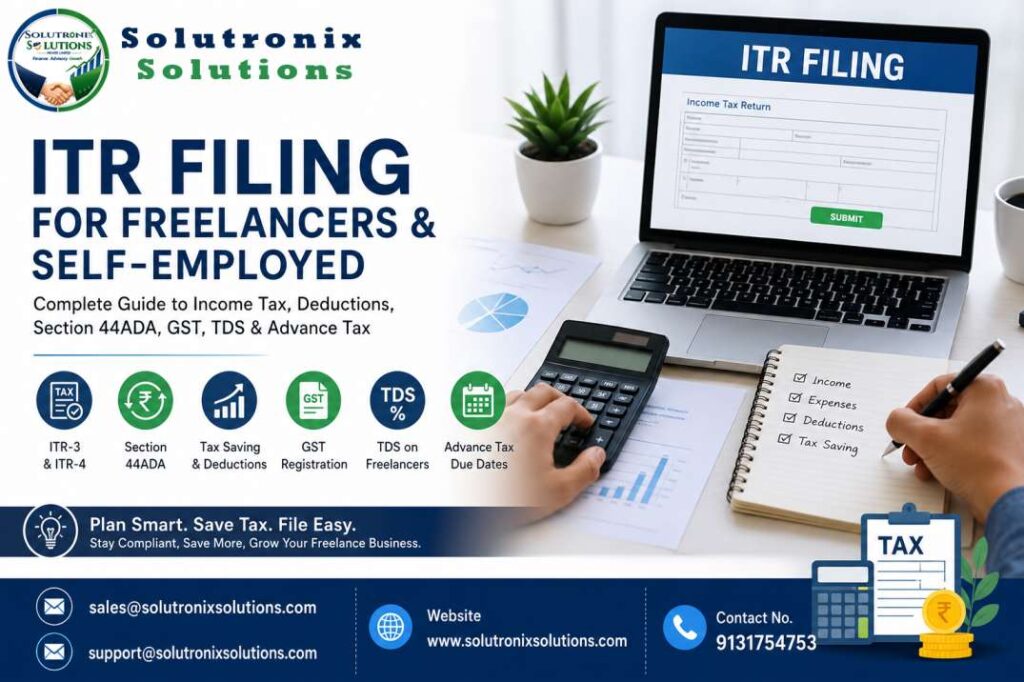
ITR Filing for Freelancers & Self-Employed Professionals: Everything You Need to Know
India has become one of the world’s fastest-growing freelance economies. Professionals such as software developers, digital marketers, graphic designers, consultants, architects, doctors, content writers, YouTubers, influencers, photographers, and other self-employed individuals are increasingly choosing independent careers over traditional employment.
While freelancing offers flexibility and unlimited earning potential, it also brings tax responsibilities. Every freelancer and self-employed professional earning taxable income must understand how Income Tax Return (ITR) filing works.
This comprehensive guide explains taxation, deductions, GST, advance tax, presumptive taxation, TDS, and the complete ITR filing process for freelancers in India.
Who is Considered a Freelancer?
Under the Income Tax Act, income earned by using professional knowledge, technical expertise, manual skills, or intellectual abilities is treated as “Profits and Gains from Business or Profession (PGBP).”
Common freelance professions include:
- Software Developers
- Web Designers
- Graphic Designers
- Digital Marketing Experts
- SEO Consultants
- Content Writers
- Bloggers
- YouTubers
- Social Media Influencers
- Video Editors
- Chartered Accountants
- Architects
- Lawyers
- Doctors
- Engineers
- Business Consultants
- Freelance Trainers
- Photographers
- Fashion Designers
- Interior Designers
If you receive payments from multiple clients instead of a monthly salary from one employer, you are generally treated as a freelancer or self-employed professional for tax purposes.
Is ITR Filing Mandatory for Freelancers?
Yes.
You must file an Income Tax Return if your total income exceeds the basic exemption limit under the applicable tax regime or if you are otherwise required to file under the Income Tax Act.
Apart from legal compliance, filing ITR offers several benefits:
- Easy approval of home, business, and personal loans
- Visa processing support
- Financial credibility
- Claiming TDS refunds
- Carry forward of business losses
- Better credit profile
Income Tax Slabs for Freelancers
Freelancers can choose either:
- New Tax Regime
- Old Tax Regime
New Tax Regime
| Annual Income | Tax Rate |
|---|---|
| Up to ₹3,00,000 | Nil |
| ₹3,00,001 – ₹7,00,000 | 5% |
| ₹7,00,001 – ₹10,00,000 | 10% |
| ₹10,00,001 – ₹12,00,000 | 15% |
| ₹12,00,001 – ₹15,00,000 | 20% |
| Above ₹15,00,000 | 30% |
Old Tax Regime (Individuals below 60 years)
| Annual Income | Tax Rate |
| Up to ₹2.5 lakh | Nil |
| ₹2.5 – ₹5 lakh | 5% |
| ₹5 – ₹10 lakh | 20% |
| Above ₹10 lakh | 30% |
The old regime allows various deductions under Sections 80C, 80D, 80E, and others, whereas the new regime offers lower tax rates with fewer deductions.
Which ITR Form Should Freelancers File?
ITR-3
Use ITR-3 if:
- You maintain books of accounts
- You claim actual business expenses
- You do not opt for presumptive taxation
ITR-4 (Sugam)
Use ITR-4 if:
- You opt for Presumptive Taxation under Section 44ADA
- Gross receipts are within the prescribed limits
- You are an eligible professional
Presumptive Taxation under Section 44ADA
Section 44ADA is one of the biggest tax-saving provisions for professionals.
Instead of maintaining detailed books of accounts, eligible professionals can declare 50% of gross receipts as taxable income, and the remaining 50% is treated as deemed expenses.
Eligibility
- Resident Individual
- Resident Partnership Firm (excluding LLP)
- Resident HUF
- Specified Professionals
Turnover Limit
- Up to ₹50 lakh (generally)
- Higher threshold may apply where cash receipts are within prescribed limits under current provisions.
Benefits
- No detailed books of accounts
- No audit requirement (subject to conditions)
- Easy ITR filing
- Reduced compliance burden
Business Expenses That Can Be Claimed
Freelancers filing under the normal taxation scheme can deduct expenses incurred wholly and exclusively for business purposes.
Examples include:
- Office Rent
- Internet Bills
- Mobile Bills
- Laptop & Computer
- Software Subscriptions
- Domain & Hosting
- Advertising Expenses
- Travel Expenses
- Electricity Bills
- Office Furniture
- Printing & Stationery
- Professional Fees
- Accounting Charges
- Consultancy Charges
- Repairs & Maintenance
- Vehicle Expenses (business use)
- Business Insurance
- Cloud Storage
- Internet Tools
- AI Tool Subscriptions
- Video Editing Software
- Camera Equipment
- Office Equipment
Expenses That Cannot Be Claimed
The following are generally not allowable:
- Personal expenses
- Income Tax paid
- Penalties and fines
- Cash expenses exceeding prescribed limits
- Illegal expenses
- Excessive payments to related parties beyond fair market value
GST Registration for Freelancers
GST registration becomes mandatory in specified situations, such as when aggregate turnover crosses the applicable threshold or in certain categories where compulsory registration applies.
For many service providers, GST is charged at 18%, though the rate depends on the nature of the services.
After registration, freelancers are generally required to:
- Issue GST invoices
- File GST Returns
- Pay GST collected
- Maintain GST records
TDS on Freelancer Income
Clients may deduct TDS before making payments.
Common TDS provisions include:
| Section | Nature | TDS Rate |
| 194J | Professional Services | 10% |
| 194H | Commission/Brokerage | 5% |
| 194C | Contracts | 1% / 2% |
The deducted TDS can be claimed while filing your Income Tax Return.
Advance Tax for Freelancers
If your total tax liability exceeds ₹10,000 during the financial year, advance tax must generally be paid.
Due Dates
| Due Date | Tax Payable |
| 15 June | 15% |
| 15 September | 45% |
| 15 December | 75% |
| 15 March | 100% |
Failure to pay advance tax may attract interest under Sections 234B and 234C.
Documents Required for ITR Filing
Keep the following documents ready:
- PAN Card
- Aadhaar Card
- Bank Statements
- Form 26AS
- Annual Information Statement (AIS)
- Taxpayer Information Summary (TIS)
- Form 16A (if applicable)
- Client Invoices
- Expense Bills
- GST Returns (if registered)
- Investment Proofs
- Home Loan Interest Certificate
- Health Insurance Premium Receipts
- Business Expense Records
Step-by-Step ITR Filing Process
Step 1
Collect all income details from every client.
Step 2
Calculate gross receipts.
Step 3
Deduct eligible business expenses (or opt for Section 44ADA).
Step 4
Calculate taxable income.
Step 5
Select the appropriate ITR form.
- ITR-3
- ITR-4
Step 6
Report TDS details.
Step 7
Claim deductions.
Step 8
Calculate tax payable.
Step 9
Pay self-assessment tax, if applicable.
Step 10
Submit and verify your Income Tax Return online.
Tax Saving Options for Freelancers
Eligible deductions (depending on the tax regime) include:
| Section | Benefit |
| 80C | ELSS, PPF, EPF, Life Insurance, Tax Saver FD |
| 80CCD(1B) | Additional NPS deduction |
| 80D | Health Insurance |
| 80E | Education Loan Interest |
| 80G | Donations |
| 24(b) | Home Loan Interest |
| 80TTA | Savings Account Interest |
Common Mistakes Freelancers Should Avoid
- Not reporting all income
- Ignoring foreign income
- Missing advance tax payments
- Choosing the wrong ITR form
- Claiming personal expenses as business expenses
- Forgetting to reconcile Form 26AS and AIS
- Missing the ITR filing deadline
- Not maintaining invoices and expense records
Frequently Asked Questions (FAQs)
Can freelancers file ITR without Form 16?
Yes. Freelancers generally receive Form 16A or invoices instead of Form 16.
Which ITR is applicable?
- ITR-3 for normal business/profession.
- ITR-4 if opting for presumptive taxation under Section 44ADA.
Is GST mandatory?
GST registration depends on turnover, the nature of services, and applicable GST provisions.
Can freelancers claim laptop and internet expenses?
Yes, if they are incurred wholly and exclusively for business purposes under the normal taxation scheme.
Do freelancers need to pay advance tax?
Yes, if their estimated tax liability exceeds ₹10,000.
Conclusion
Freelancing offers tremendous flexibility, but it also requires proper tax planning and timely compliance. Understanding tax slabs, choosing the correct ITR form, maintaining proper financial records, claiming eligible deductions, paying advance tax on time, and using the benefits of Section 44ADA (where applicable) can help freelancers reduce their tax burden while staying compliant with Indian tax laws.
Whether you are a software developer, digital marketer, consultant, content creator, or any other self-employed professional, filing your Income Tax Return accurately and on time helps avoid penalties, claim refunds, and build long-term financial credibility.
ITRFiling #FreelancerTax #IncomeTax #IncomeTaxIndia #SelfEmployed #Freelancer #Section44ADA #ITR2026 #ITR2025 #TaxSaving #GST #GSTRegistration #AdvanceTax #TDS #ProfessionalIncome #BusinessIncome #ITR3 #ITR4 #IncomeTaxReturn #TaxPlanning #Finance #Accounting #Bookkeeping #TaxConsultant #CharteredAccountant #CAIndia #TaxAdvisor #DigitalMarketing #SoftwareDeveloper #GraphicDesigner #ContentWriter #WebDeveloper #Consultant #Influencer #YouTuber #Blogger #Business #SmallBusiness #StartupIndia #Entrepreneur #FreelanceBusiness #FinancialPlanning #BusinessTax #TaxDeductions #TaxRefund #OnlineITR #FinancialYear2025 #AssessmentYear2026 #IndianTax #TaxCompliance
ITR filing for freelancers, freelancer income tax, self employed tax India, income tax for freelancers, ITR-3, ITR-4, Section 44ADA, Section 44AA, Section 44AB, freelancer GST, GST registration for freelancers, freelancer tax saving, tax deductions for freelancers, business expenses, advance tax, advance tax due dates, professional income, business income, freelancer income, digital marketing freelancer tax, software developer tax, graphic designer income tax, consultant income tax, content writer tax, blogger income tax, YouTuber income tax, influencer income tax, freelance web developer tax, self-employed professionals, freelance consultant, income tax return, online ITR filing, ITR filing online, income tax India, tax return India, TDS on freelancers, Form 26AS, AIS, TIS, professional receipts, gross receipts, books of accounts, presumptive taxation, freelancer tax guide, ITR filing FY 2025-26, AY 2026-27, income tax deductions, Section 80C, Section 80D, Section 80E, Section 80CCD, professional expenses, office rent deduction, internet expense deduction, laptop depreciation, software subscription expense, business tax, small business tax, sole proprietor tax, self employed income, tax planning, GST return, freelancer bookkeeping, income tax compliance, business tax filing, online tax filing, income tax consultant, CA services, tax advisor, professional tax guide, ITR filing services, tax audit, income tax refund, tax refund, tax filing India, financial year 2025-26, assessment year 2026-27, freelancer accounting, cash basis accounting, accrual accounting, professional services tax, tax benefits, tax exemptions, online CA, income tax expert, ITR filing consultant
