








Duty Drawback Scheme Guide 2026: Complete Guide for Indian Exporters
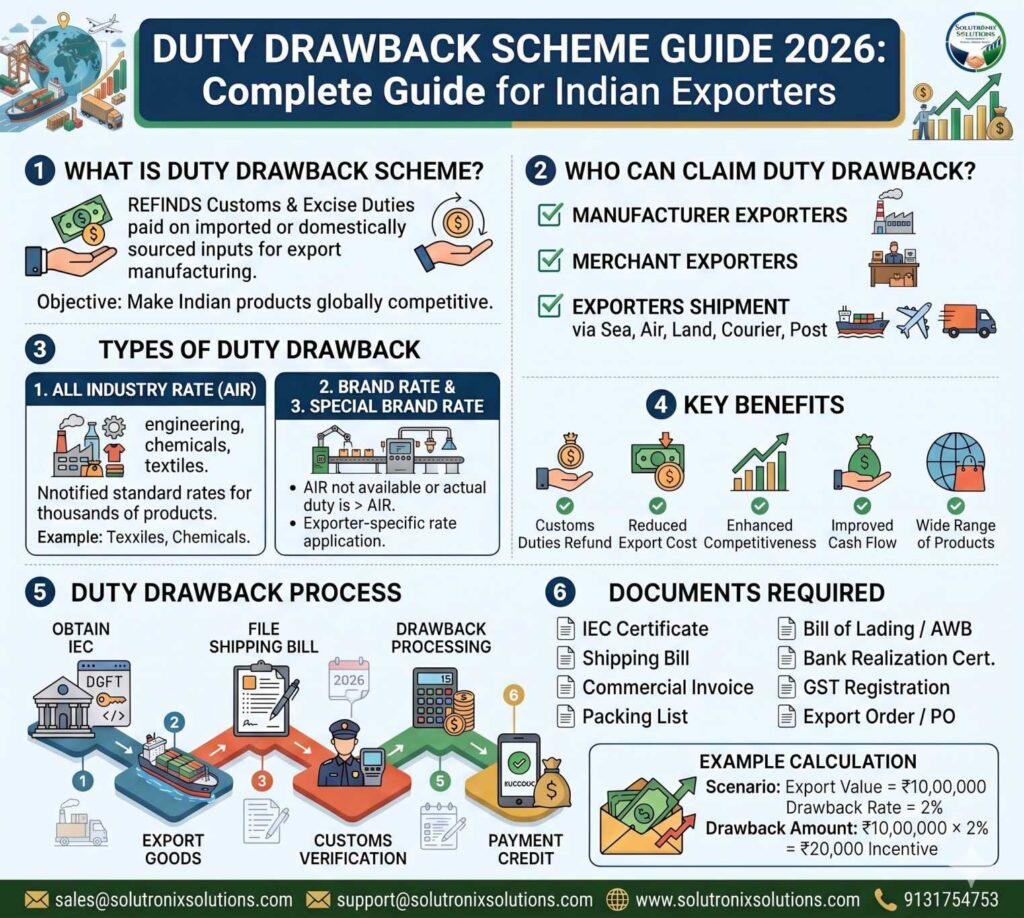
What is Duty Drawback Scheme?
The Duty Drawback Scheme is a government incentive that refunds customs and excise duties paid on imported or domestically sourced inputs used in manufacturing export products.
The objective is to make Indian products more competitive in international markets by reducing the cost burden on exporters.
Benefits of Duty Drawback Scheme
✅ Refund of customs duties paid on imported raw materials
✅ Reduces export cost and improves profit margins
✅ Enhances global competitiveness
✅ Improves cash flow for exporters
✅ Available for a wide range of export products
Who Can Claim Duty Drawback?
The following exporters are eligible:
- Manufacturer Exporters
- Merchant Exporters
- Exporters shipping through sea, air, post, courier, or land routes
Types of Duty Drawback
1. All Industry Rate (AIR)
The government notifies standard drawback rates for thousands of products.
Advantages:
- Easy to claim
- No separate calculation required
- Applicable to most exporters
Example:
- Engineering goods
- Chemicals
- Textiles
- Leather products
- Agricultural products
2. Brand Rate Drawback
Applicable when:
- AIR rate is not available
- Actual duty paid is higher than AIR
Exporter can apply for a specific rate based on actual duty incidence.
3. Special Brand Rate
Applicable when AIR drawback is less than 80% of actual duty suffered.
Duty Drawback Process
Step 1: Obtain IEC
Apply for Import Export Code from the Directorate General of Foreign Trade (DGFT).
Step 2: Export Goods
Ship goods through:
- Sea
- Air
- Land
- Courier
Step 3: File Shipping Bill
Mention drawback claim in the shipping bill while filing export documents.
Step 4: Customs Verification
Indian Customs verifies:
- Export documents
- Product details
- Quantity and value
Step 5: Drawback Processing
Customs calculates the eligible drawback amount.
Step 6: Payment Credit
The drawback amount is directly credited to the exporter’s bank account.
Documents Required
- IEC Certificate
- Shipping Bill
- Commercial Invoice
- Packing List
- Bill of Lading / Airway Bill
- Bank Realization Certificate (if required)
- GST Registration
- Export Order / Purchase Order
Example Calculation
Scenario
Product Export Value = ₹10,00,000
Duty Drawback Rate = 2%
Drawback Amount
₹10,00,000 × 2%
= ₹20,000
Exporter receives ₹20,000 as duty drawback incentive.
Industries Benefiting Most
Engineering Products


- Machine tools
- Industrial equipment
- Auto components
Agricultural Products


- Spices
- Turmeric
- Moringa
- Processed foods
Pharmaceuticals
- Medicines
- Medical devices
- Healthcare equipment
Textiles
- Garments
- Fabrics
- Home furnishing products
Duty Drawback vs RoDTEP
| Feature | Duty Drawback | RoDTEP |
|---|---|---|
| Covers Customs Duty | Yes | No |
| Covers Hidden Taxes | Limited | Yes |
| Applicable Products | Selected Products | Most Export Products |
| Claim Method | Customs Shipping Bill | ICEGATE System |
| Objective | Refund Input Duties | Refund Embedded Taxes |
Many exporters claim RoDTEP along with eligible drawback benefits depending on product category and applicable regulations.
Common Reasons for Rejection
❌ Incorrect HSN Code
❌ Wrong Shipping Bill Declaration
❌ Mismatch in Export Documents
❌ Incomplete Bank Details
❌ Product Not Eligible
❌ Customs Compliance Issues
Tips to Maximize Benefits
- Use correct HSN codes.
- Declare drawback claim at the time of export.
- Maintain complete documentation.
- Track notifications for revised rates.
- Consult a customs expert for high-value exports.
- Verify eligibility under both Duty Drawback and RoDTEP.
Conclusion
The Duty Drawback Scheme remains one of India’s most important export incentives. By refunding duties paid on inputs used in exported goods, it helps exporters reduce costs, improve profitability, and compete effectively in global markets. For companies like Swastic Global Export and exporters of wellness products such as Ashwagandha, Moringa, Turmeric, engineering goods, and medical equipment, leveraging Duty Drawback can significantly improve export margins.
